
Search Results (Searched for: gs swing arm)
 650ed
650ed
Welcome aboard!
I can't say much about cafe do's & don'ts, but here are some tips that you may find helpful:
Many newbies and not so newbies run into or issues with their bikes which could be easily avoided with a little preparation or information. Here are a couple recommendations that I hope you will find useful.
Before riding your KZ you should take a little time to become familiar with it. Simple things like checking the oil, tire pressures, etc. are explained in the Kawasaki Owner's Manual. If you bike didn't come with one (they normally are in a little holder on the bottom of the seat) you can usually find one on eBay - be sure to get one for your exact year/model.
MANUAL
You really should consider buying the Kawasaki Factory Service Manual for your bike. The factory service manual provides instructions on the various maintenance procedures and schedules for your bike, procedures for diagnosing problems, proper torque values for the various fasteners (VERY IMPORTANT), and insight into how each system on your bike works even if you are not repairing that system. Studying the manual before you attempt performing service on your bike will impart an understanding of the system you are working on which will increase the odds of success.
The manuals usually are readily available for most models on eBay and other sources; but be sure to get one that has your specific year and model in it as there are differences between the various KZ650 models. I do not recommend Clymers, Haynes, or other aftermarket manuals as I have seen instances where they provide inaccurate advice. You may decide to use those to supplement the factory manual, but in my opinion they are not a suitable substitute. If you have trouble finding one for your model ask us to help.
TOOLS
WARNING! Do not even try to use Phillips screwdrivers on the Kawasaki cross head screws. Despite their appearance they are not Phillips screws. They are Japanese Industrial Standard (JIS) screws. The tips of Phillips screwdrivers are too long & pointed to allow the 4 blades of the screwdriver to properly engage the screws, so when you apply force the screw head slots will deform and look like crap. The fact is that Phillips screws were deliberately designed to have the screwdriver bit "cam out." This was done to prevent production line assembly from over-tightening, stripping, or breaking the screws. JIS screws do not have this problem. A proper fitting JIS bit can tighten a JIS screw to and beyond the torque spec without camming out. Here's the good news - you can easily modify standard Phillips screwdriver tips to fit the JIS screws.
I have ground down the tips of DeWalt #2 and DeWalt #3 Phillips to make them fit JIS screws. The large crosshead screws on the cases take modified #3 bits (or genuine #3 JIS bits). To modify the DeWalt bits you need to grind the very tip a little, then test fit, then grind a little more and test fit, etc. until the bit no longer "rocks" back and forth in the screwhead. Picture 1 below shows how a DeWalt #3 bit fits the case screws of my KZ650 after being ground properly. The #2 DeWalt bits can be modified the same way to fit smaller JIS screws. Pictures 2 and 3 below shows DeWalt #2 and #3 modified bits.
I did find a place that sells authentic JIS bits. They don't list the #3 bit, but if you contact them they can provide the #3 JIS bits even though they are not listed on the website. These folks were very easy to work with, and the authentic bits do work great. Here's their site:
www.rjrcooltools.com/shop_item_detail.cfm?subcat_ID=89
Pictures 4 & 5 below show a comparison between my home made modified bits with the authentic JIS bits.
PICTURE 1

PICTURE 2

PICTURE 3

PICTURE 4

PICTURE 5

Before reaching for that wrench or ratchet consider the following. The bolts are steel, but your engine and front forks are aluminum. The bolts are much tougher than the aluminum and if over tightened will strip the aluminum threads. Although these can be repaired, preventing damage by applying proper torque will save you grief, time, and money. Tightening fasteners properly requires torque wrenches. Various vendors, including Snap-on, CDI, Sears, etc., market torque wrenches. The two most popular types are the bar type and micrometer type. Either will work, but the micrometer type is a bit easier to use, especially if you are tightening several fasteners with the same torque - such as cylinder head covers. You will need a torque wrench calibrated in INCH POUNDS for many of the bolts. You will also need a torque wrench calibrated in FOOT POUNDS for the larger bolts. Don't try to use the foot pounds wrench on the smaller bolts as it will not be sensitive enough at low torque settings to provide accurate torque. There are many fasteners that require low torque. These include such things as 6mm oil pan bolts, cylinder head cover bolts, etc. for which the torque in 61-78 inch pounds. These low torque bolts require a wrench that is accurate at low settings and this wrench should be graduated in inch pounds. In addition, there are numerous high torque fasteners such as the front axle nuts (51 - 65 foot pounds) or swing arm pivot shaft nuts (58 - 87 foot pounds). These require a wrench that is accurate at higher settings; this wrench should be graduated in foot pounds. Using the proper torque wrenches to correctly tighten fasteners will help prevent damage and contribute to a safe bike. The Kawasaki Service Manual will list the various torque specs for the bolts. I suggest you get the manual before buying the torque wrenches so you can decide which wrenches best meet the torque specs.
Consider buying a can of Kroil penetrating oil and use it to soak stubborn fasteners for a couple days before trying to loosen them. Remember, the original screws and bolts were installed on your bike when Jimmy Carter was President, so many of them may be hard to remove. Kroil can be bought online, at guns shows, and at some other venues.
MOTOR OIL
The ingredients in oils have changed over the years. For example, today's Castrol GTX oil (and pretty much all other AUTOMOBILE oil) is not the same as it was in the 1980's. Back then it worked great in KZ bikes. But, things have changed. Early AUTOMOBILE oils contained zinc phosphorus compounds (ZDDP) to protect engine components from metal to metal contact. This was good for engines, but it was found to be destructive to catalytic converters. Consequently, in AUTOMOBILE oils ZDDP was virtually eliminated and replaced with different chemistry generically referred to as "Friction Modifiers." These work fine and offer good protection for normal AUTOMOBILE engines. However, today's AUTOMOBILE oil "Friction Modifiers" are destructive to wet clutches. KZ bikes (and many other brands) have wet clutches. As a result of these oil chemistry changes a distinction needed to be made between those oils which are suitable for wet clutches and those which are not. That distinction was documented by the Japanese Engine Oil Standards Implementation Panel (JASO). JASO developed a number of different oil specifications for different applications. The specifications that apply to 4 stroke motorcycles fall under the "4T Specifications." Within the 4T specifications the JASO MA class oils are specifically formulated for 4 stroke motorcycles with wet clutches.
There are synthetic, semi-synthetic, and non-synthetic oils that meet the JASO-MA standard and any of them will work ok. However, using oils that are not designated as meeting the JASO-MA standard is destructive to KZ clutches.
Good luck with your bike. Ed
I can't say much about cafe do's & don'ts, but here are some tips that you may find helpful:
Many newbies and not so newbies run into or issues with their bikes which could be easily avoided with a little preparation or information. Here are a couple recommendations that I hope you will find useful.
Before riding your KZ you should take a little time to become familiar with it. Simple things like checking the oil, tire pressures, etc. are explained in the Kawasaki Owner's Manual. If you bike didn't come with one (they normally are in a little holder on the bottom of the seat) you can usually find one on eBay - be sure to get one for your exact year/model.
MANUAL
You really should consider buying the Kawasaki Factory Service Manual for your bike. The factory service manual provides instructions on the various maintenance procedures and schedules for your bike, procedures for diagnosing problems, proper torque values for the various fasteners (VERY IMPORTANT), and insight into how each system on your bike works even if you are not repairing that system. Studying the manual before you attempt performing service on your bike will impart an understanding of the system you are working on which will increase the odds of success.
The manuals usually are readily available for most models on eBay and other sources; but be sure to get one that has your specific year and model in it as there are differences between the various KZ650 models. I do not recommend Clymers, Haynes, or other aftermarket manuals as I have seen instances where they provide inaccurate advice. You may decide to use those to supplement the factory manual, but in my opinion they are not a suitable substitute. If you have trouble finding one for your model ask us to help.
TOOLS
WARNING! Do not even try to use Phillips screwdrivers on the Kawasaki cross head screws. Despite their appearance they are not Phillips screws. They are Japanese Industrial Standard (JIS) screws. The tips of Phillips screwdrivers are too long & pointed to allow the 4 blades of the screwdriver to properly engage the screws, so when you apply force the screw head slots will deform and look like crap. The fact is that Phillips screws were deliberately designed to have the screwdriver bit "cam out." This was done to prevent production line assembly from over-tightening, stripping, or breaking the screws. JIS screws do not have this problem. A proper fitting JIS bit can tighten a JIS screw to and beyond the torque spec without camming out. Here's the good news - you can easily modify standard Phillips screwdriver tips to fit the JIS screws.
I have ground down the tips of DeWalt #2 and DeWalt #3 Phillips to make them fit JIS screws. The large crosshead screws on the cases take modified #3 bits (or genuine #3 JIS bits). To modify the DeWalt bits you need to grind the very tip a little, then test fit, then grind a little more and test fit, etc. until the bit no longer "rocks" back and forth in the screwhead. Picture 1 below shows how a DeWalt #3 bit fits the case screws of my KZ650 after being ground properly. The #2 DeWalt bits can be modified the same way to fit smaller JIS screws. Pictures 2 and 3 below shows DeWalt #2 and #3 modified bits.
I did find a place that sells authentic JIS bits. They don't list the #3 bit, but if you contact them they can provide the #3 JIS bits even though they are not listed on the website. These folks were very easy to work with, and the authentic bits do work great. Here's their site:
www.rjrcooltools.com/shop_item_detail.cfm?subcat_ID=89
Pictures 4 & 5 below show a comparison between my home made modified bits with the authentic JIS bits.
PICTURE 1
PICTURE 2
PICTURE 3
PICTURE 4
PICTURE 5
Before reaching for that wrench or ratchet consider the following. The bolts are steel, but your engine and front forks are aluminum. The bolts are much tougher than the aluminum and if over tightened will strip the aluminum threads. Although these can be repaired, preventing damage by applying proper torque will save you grief, time, and money. Tightening fasteners properly requires torque wrenches. Various vendors, including Snap-on, CDI, Sears, etc., market torque wrenches. The two most popular types are the bar type and micrometer type. Either will work, but the micrometer type is a bit easier to use, especially if you are tightening several fasteners with the same torque - such as cylinder head covers. You will need a torque wrench calibrated in INCH POUNDS for many of the bolts. You will also need a torque wrench calibrated in FOOT POUNDS for the larger bolts. Don't try to use the foot pounds wrench on the smaller bolts as it will not be sensitive enough at low torque settings to provide accurate torque. There are many fasteners that require low torque. These include such things as 6mm oil pan bolts, cylinder head cover bolts, etc. for which the torque in 61-78 inch pounds. These low torque bolts require a wrench that is accurate at low settings and this wrench should be graduated in inch pounds. In addition, there are numerous high torque fasteners such as the front axle nuts (51 - 65 foot pounds) or swing arm pivot shaft nuts (58 - 87 foot pounds). These require a wrench that is accurate at higher settings; this wrench should be graduated in foot pounds. Using the proper torque wrenches to correctly tighten fasteners will help prevent damage and contribute to a safe bike. The Kawasaki Service Manual will list the various torque specs for the bolts. I suggest you get the manual before buying the torque wrenches so you can decide which wrenches best meet the torque specs.
Consider buying a can of Kroil penetrating oil and use it to soak stubborn fasteners for a couple days before trying to loosen them. Remember, the original screws and bolts were installed on your bike when Jimmy Carter was President, so many of them may be hard to remove. Kroil can be bought online, at guns shows, and at some other venues.
MOTOR OIL
The ingredients in oils have changed over the years. For example, today's Castrol GTX oil (and pretty much all other AUTOMOBILE oil) is not the same as it was in the 1980's. Back then it worked great in KZ bikes. But, things have changed. Early AUTOMOBILE oils contained zinc phosphorus compounds (ZDDP) to protect engine components from metal to metal contact. This was good for engines, but it was found to be destructive to catalytic converters. Consequently, in AUTOMOBILE oils ZDDP was virtually eliminated and replaced with different chemistry generically referred to as "Friction Modifiers." These work fine and offer good protection for normal AUTOMOBILE engines. However, today's AUTOMOBILE oil "Friction Modifiers" are destructive to wet clutches. KZ bikes (and many other brands) have wet clutches. As a result of these oil chemistry changes a distinction needed to be made between those oils which are suitable for wet clutches and those which are not. That distinction was documented by the Japanese Engine Oil Standards Implementation Panel (JASO). JASO developed a number of different oil specifications for different applications. The specifications that apply to 4 stroke motorcycles fall under the "4T Specifications." Within the 4T specifications the JASO MA class oils are specifically formulated for 4 stroke motorcycles with wet clutches.
There are synthetic, semi-synthetic, and non-synthetic oils that meet the JASO-MA standard and any of them will work ok. However, using oils that are not designated as meeting the JASO-MA standard is destructive to KZ clutches.
Good luck with your bike. Ed
Replied by 80B4 on topic kz750 custom swingarm fab
12 Nov 2014 19:02 80B4
80B4
I'm using the swingarm from a 2000 police bike on my 750 twin. It's got more bracing, needle bearings and all of the consumables are still available from Kawasaki. I paid $30 for it. Just an idea.
 531blackbanshee
i know the later models kz 1000 used a needle bearing.
it seems that the needles can be used as an upgrade for the old bushings but you need the needle bearing center bushing which seems to be no longer available.
leon
it seems that the needles can be used as an upgrade for the old bushings but you need the needle bearing center bushing which seems to be no longer available.
leon
Replied by Bovine on topic kz750 custom swingarm fab
12 Nov 2014 08:12
Bovine
Leon, Got it... I might bug you some more on this issue, I hate to tap the hard work done by others but hey if it shortens the learning curve, saves my HIDE and keeps me from wasting time and money I 'm all over it. Its been awhile since I've bent one of these in-line fours around a curve, but I can't forget that feeling of, is it going to high side me or is it going to wobble into the on coming lane! Ah, the good old days!
, I'm at the point where I need to decide how much I'm going to do to the frame. Its' bare, and just scremming for me to start working on it. I have a set of tapered stering head bearings, and two stock swing arms. Is there a needle bearing set that fits the inside Dim. of the stock arms pivot bore? Or should I just hunt down the GPZ arm and get it over with? I am going to look any of the treads on this forum that discuss bracing the frame, again I don't want to do something cus' its cool. I do want to work at incressing the frame and running gears abilitys. I know you have plenty of projects etc. to focus on, but I really do apreciate your time!
Rod ...
, I'm at the point where I need to decide how much I'm going to do to the frame. Its' bare, and just scremming for me to start working on it. I have a set of tapered stering head bearings, and two stock swing arms. Is there a needle bearing set that fits the inside Dim. of the stock arms pivot bore? Or should I just hunt down the GPZ arm and get it over with? I am going to look any of the treads on this forum that discuss bracing the frame, again I don't want to do something cus' its cool. I do want to work at incressing the frame and running gears abilitys. I know you have plenty of projects etc. to focus on, but I really do apreciate your time!
Rod ...
Replied by 531blackbanshee on topic kz750 custom swingarm fab
12 Nov 2014 07:33
531blackbanshee
thanks for the kind words bovine.
imho,
stiffening up any part of these bikes is going to help tighten the handling up .
whether it's a fork brace, stiffer fork legs, stronger swingarm or better tires.
so you can improve each piece as you see fit.
as long as the arms are kept at four inches or less over,most of us mortals are not going to be able to tell a huge difference in hustling these old bikes around a corner.
leon
imho,
stiffening up any part of these bikes is going to help tighten the handling up .
whether it's a fork brace, stiffer fork legs, stronger swingarm or better tires.
so you can improve each piece as you see fit.
as long as the arms are kept at four inches or less over,most of us mortals are not going to be able to tell a huge difference in hustling these old bikes around a corner.
leon
531blackbanshee
bovine,
i have found that the original swingarms are such noodles that a stronger swingarm even if it is 2-3 inches longer will not negatively affect the handling and in most cases the handling improves because you now have an arm that is capable of holding the contact patch in much closer contact with the surface.
i do know that my z1r with a 2 1/2 inch over swingarm and 190 mm rear tire handles much better than it did with the stock arm and 120mm wide rear tire. :evil:
although i can't get to all of the edges of the 190 because i would have to drag off a fair bit of hard parts to get there :sick: .
in all reality a 160/170 is plenty of tire,but if you don't have enough strength in the legs of the swingarm to keep the axle in the same plane as the pivot bolt it is going to weave in hard corners.
the frames get alot of attention for ill handling but imho the swingarms are the biggest culprits.
i can't wait until tri gets his stealth overbraced stock swingarm
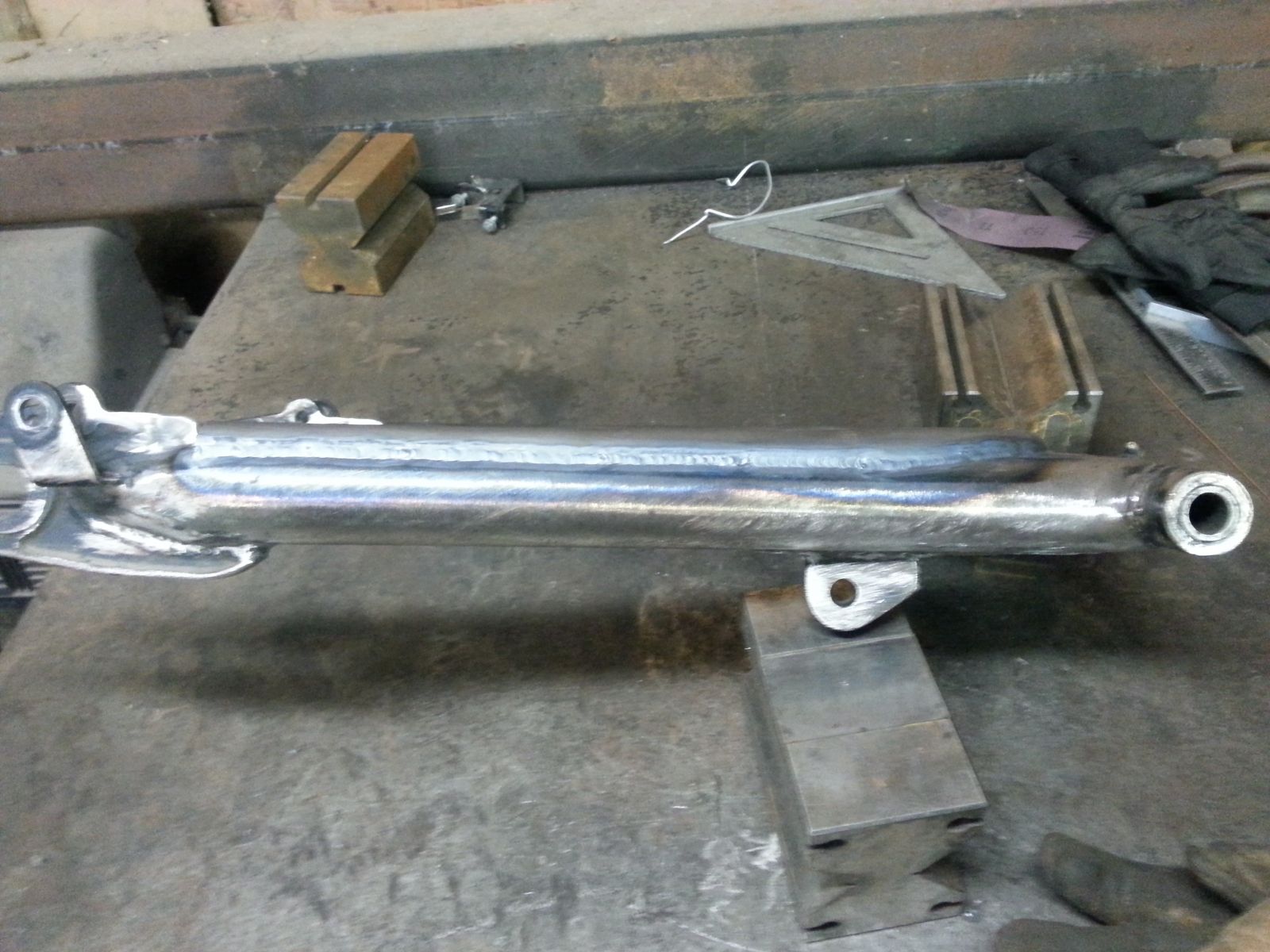 mounted up with a decent tire on his bike.
then see how much it improves the handling of a stock length stock wheel sticky tired bike in the fast corners
:whistle: .
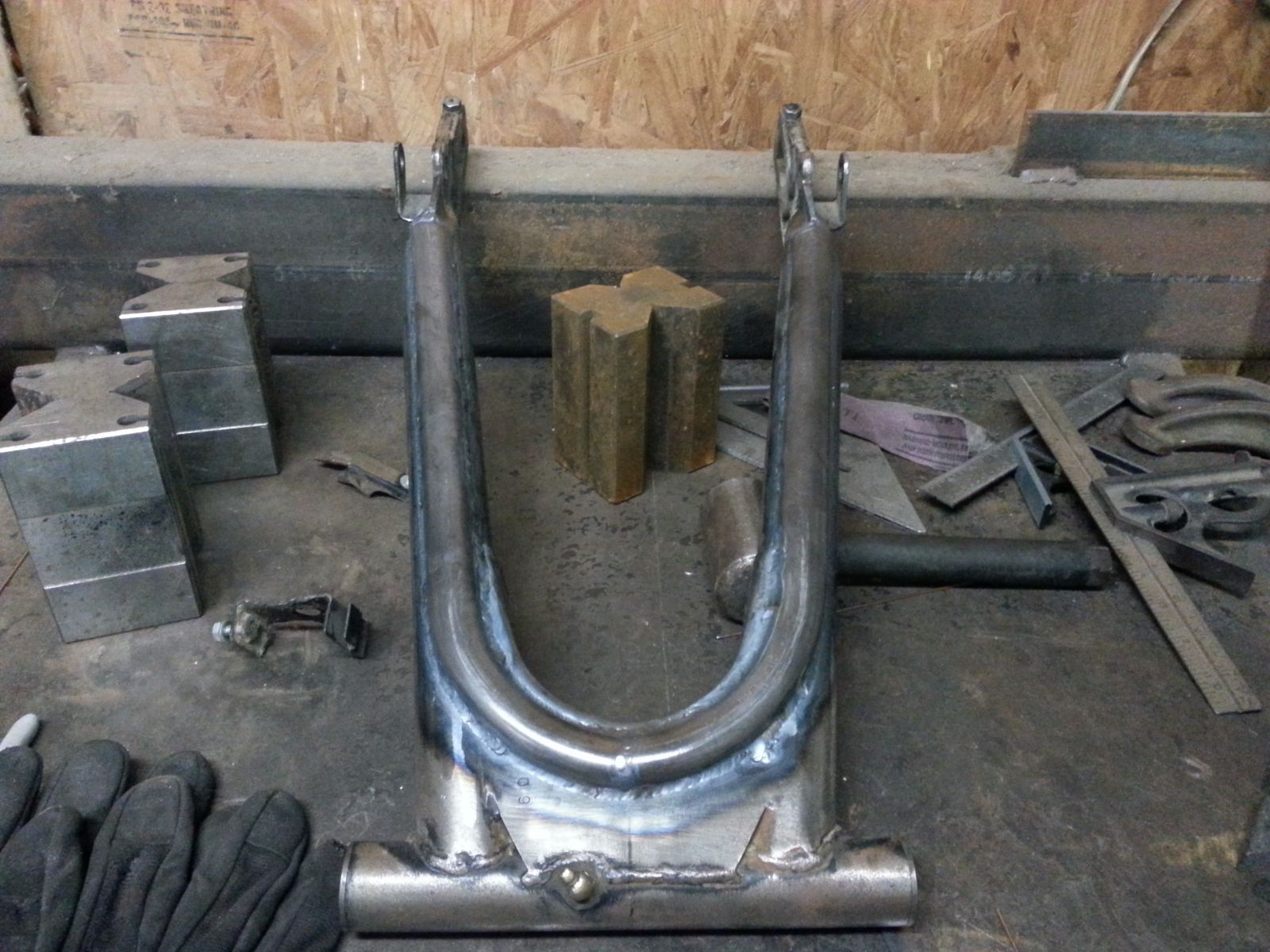
doug,
yessir just a slight amount of progress.
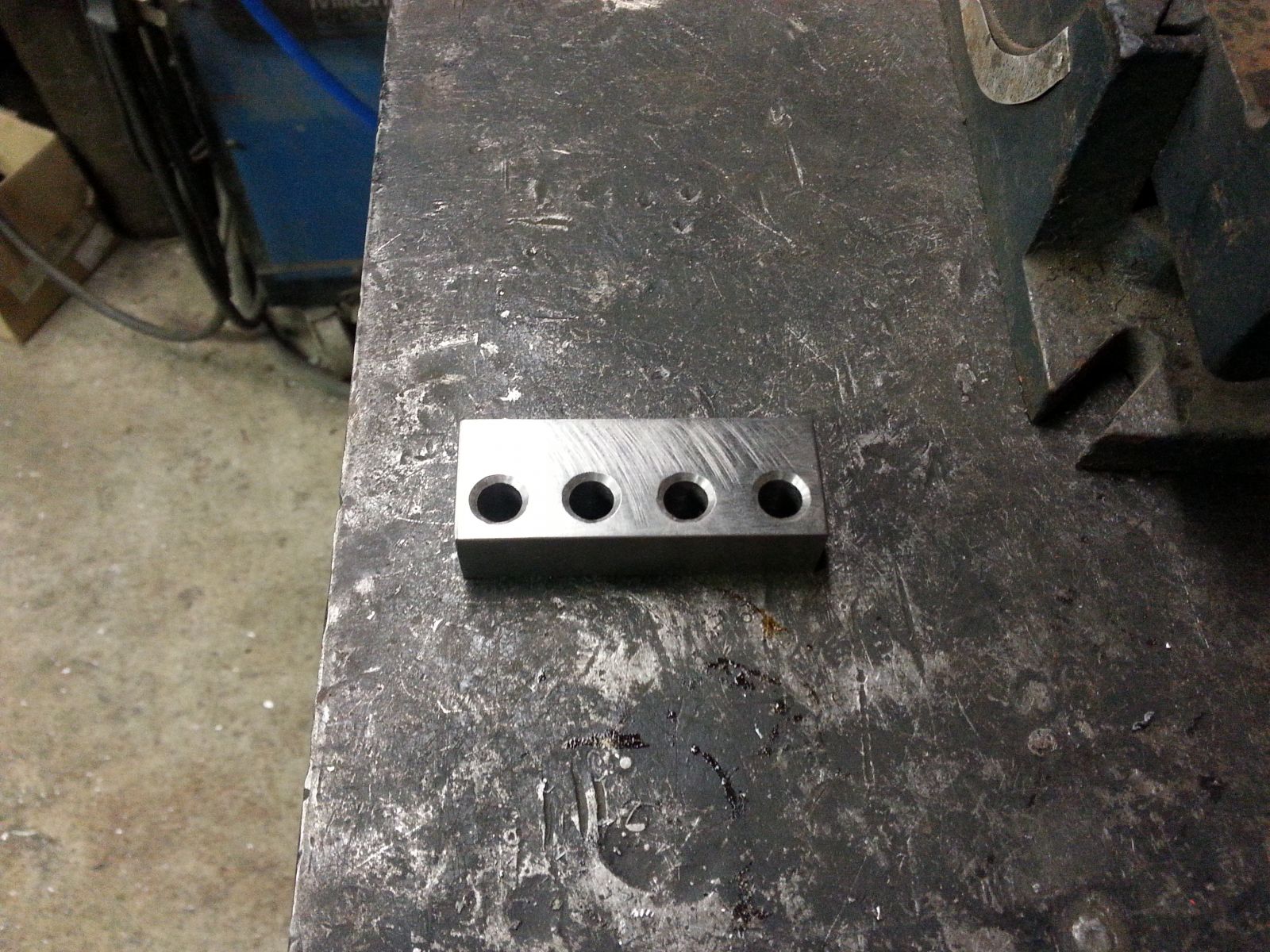
it doesn't look like much.
but when you band saw it out of a big chunk,mill it square,fit and mill to size then sand out (most)the machining mark and layout holes and drill and chamfer the holes it eats up some time :blush: .
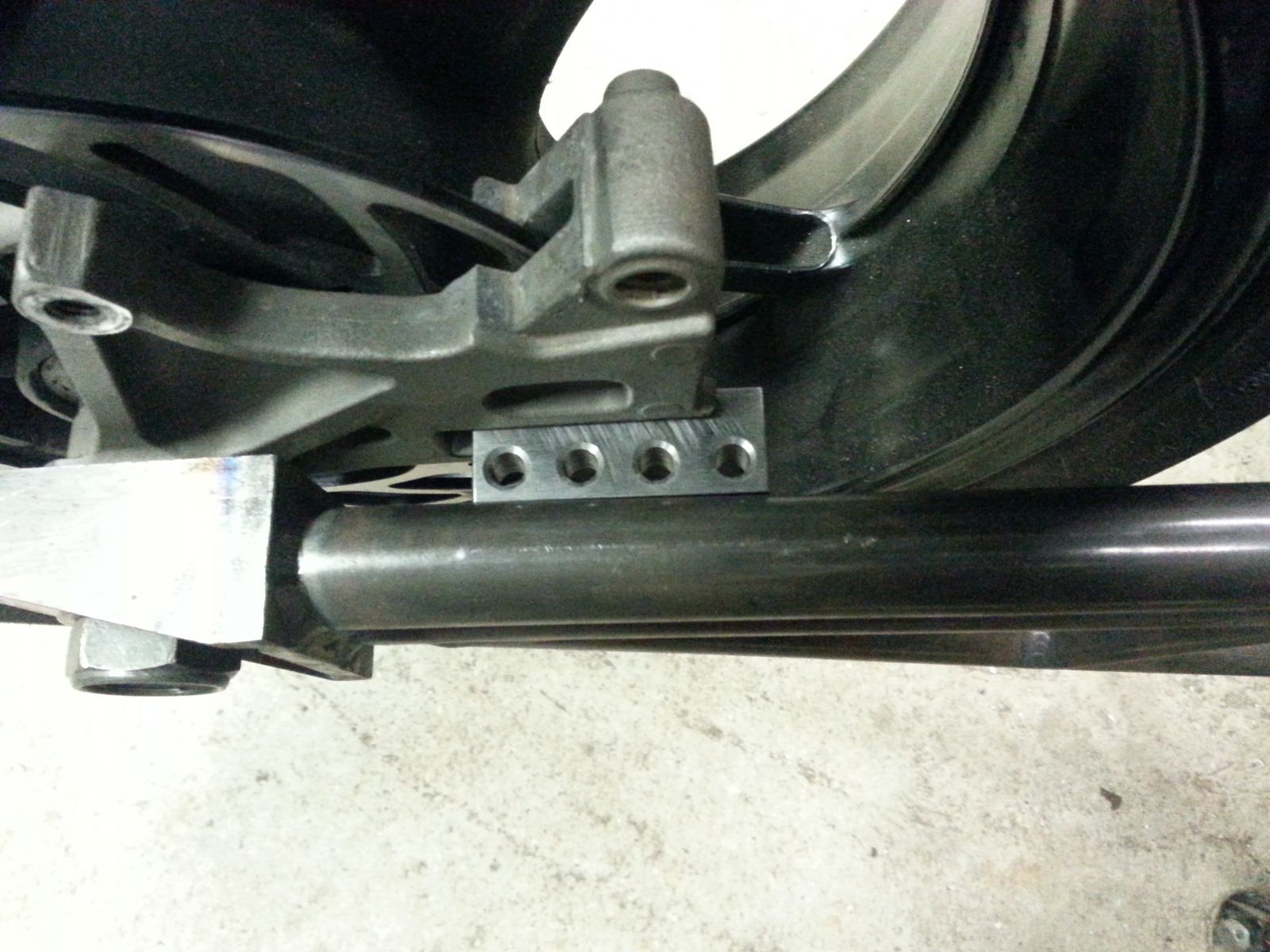
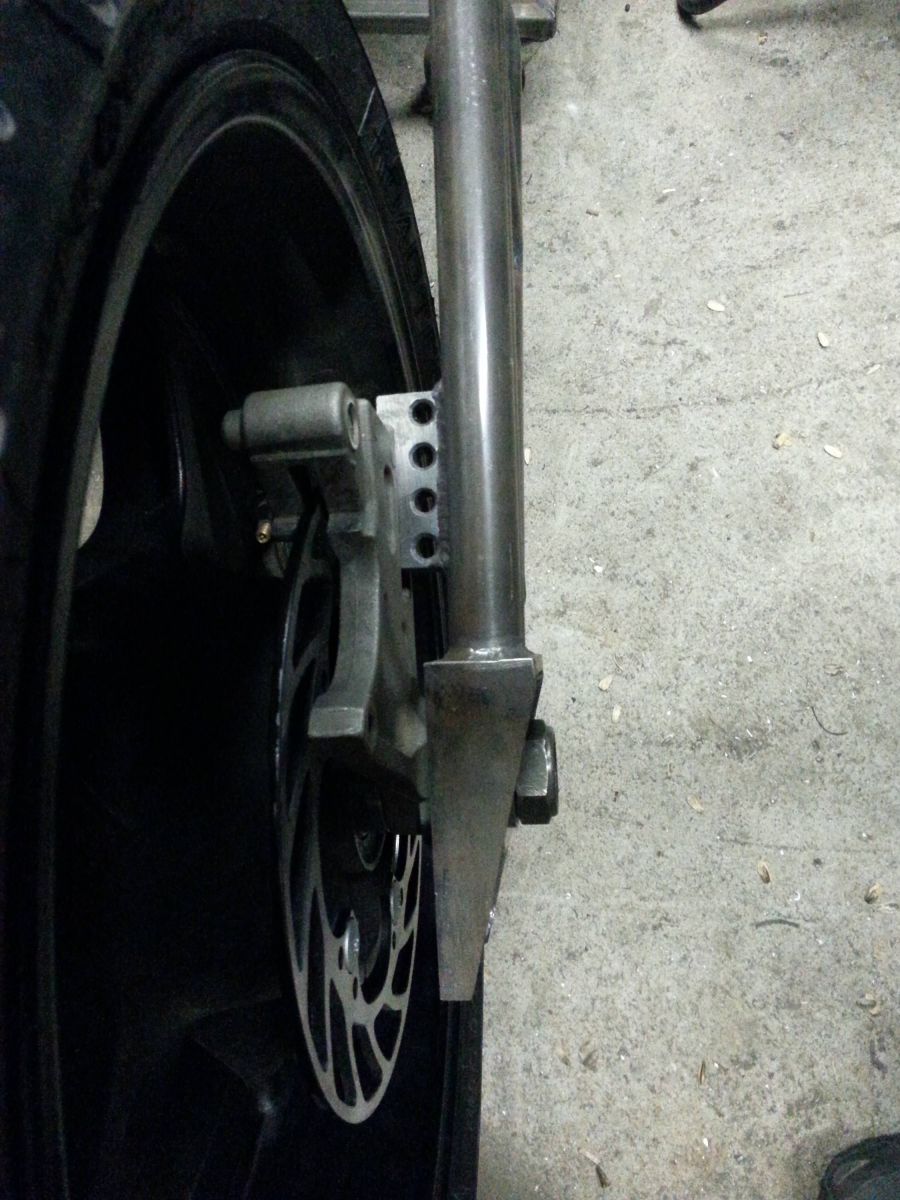
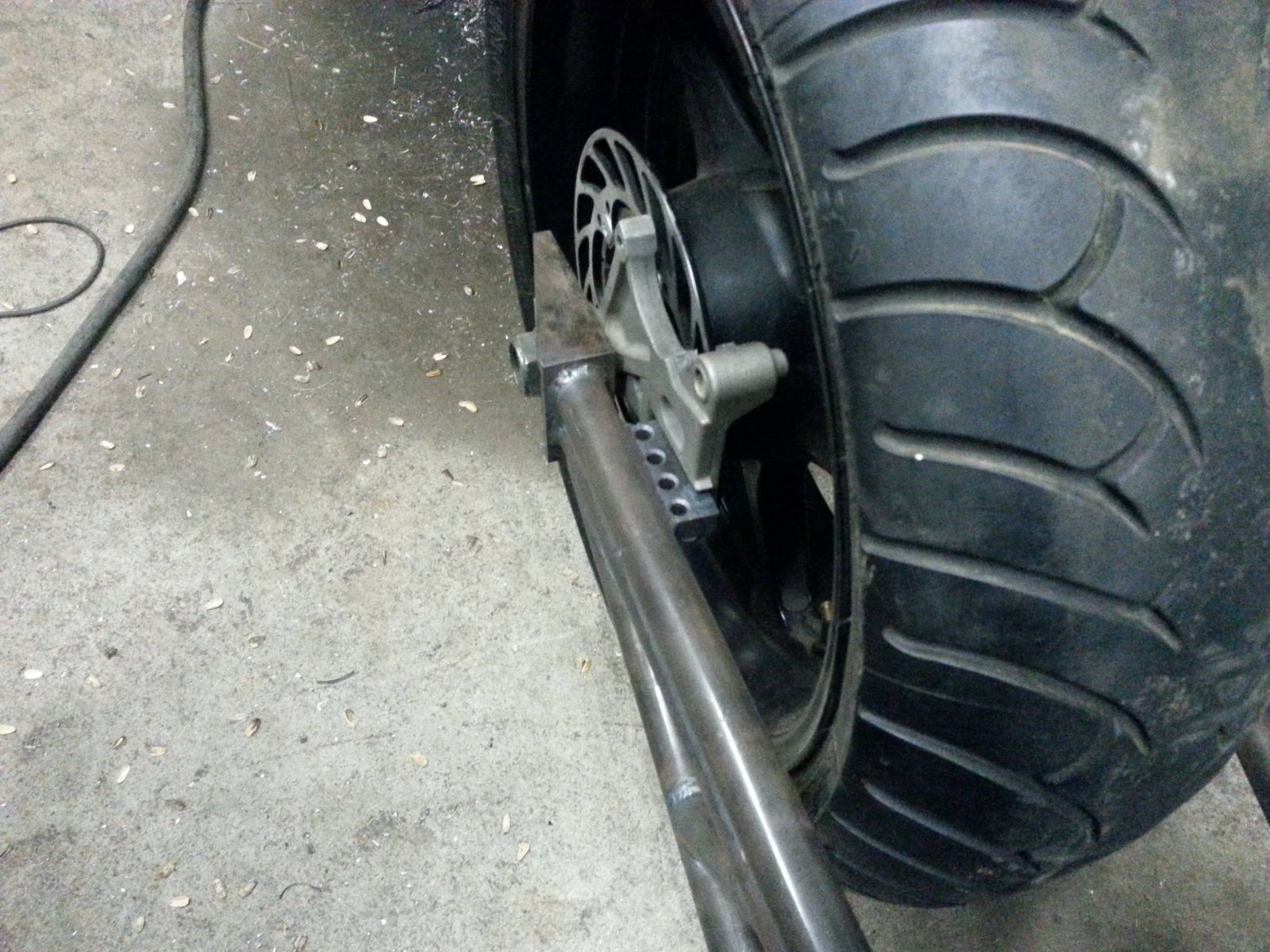
but after it was welded in i was pretty satisfied with it.
leon
i have found that the original swingarms are such noodles that a stronger swingarm even if it is 2-3 inches longer will not negatively affect the handling and in most cases the handling improves because you now have an arm that is capable of holding the contact patch in much closer contact with the surface.
i do know that my z1r with a 2 1/2 inch over swingarm and 190 mm rear tire handles much better than it did with the stock arm and 120mm wide rear tire. :evil:
although i can't get to all of the edges of the 190 because i would have to drag off a fair bit of hard parts to get there :sick: .
in all reality a 160/170 is plenty of tire,but if you don't have enough strength in the legs of the swingarm to keep the axle in the same plane as the pivot bolt it is going to weave in hard corners.
the frames get alot of attention for ill handling but imho the swingarms are the biggest culprits.
i can't wait until tri gets his stealth overbraced stock swingarm
then see how much it improves the handling of a stock length stock wheel sticky tired bike in the fast corners
:whistle: .
doug,
yessir just a slight amount of progress.
it doesn't look like much.
but when you band saw it out of a big chunk,mill it square,fit and mill to size then sand out (most)the machining mark and layout holes and drill and chamfer the holes it eats up some time :blush: .
but after it was welded in i was pretty satisfied with it.
leon
Replied by kaw-a-holic on topic 1975 KZ 900 , ZRX Swingarm, 89 GSXR front end
11 Nov 2014 18:56 kaw-a-holic
Very nicely done. I really like the orange against the silver frame.
Replied by NakedFun on topic 1975 KZ 900 , ZRX Swingarm, 89 GSXR front end
11 Nov 2014 18:00 NakedFun
It looks like PPG Hot Licks Orange. My brother and I painted his Factory Five Cobra that color.
Cory
Cory
Replied by tk11b40 on topic 1975 KZ 900 , ZRX Swingarm, 89 GSXR front end
11 Nov 2014 17:34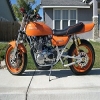 tk11b40
Thank you Cory.
I was totally freaked out about cutting these. I don't even know what color this is, all I know is its PPG. So if I trashed anything, it would have been very hard to recover.
I put the photos up so others can see it will turn out if you are patient. It looks "factory".
This is the theme..trying o keep it looking like Kawasaki decided to build a KZ 900 today..
I was totally freaked out about cutting these. I don't even know what color this is, all I know is its PPG. So if I trashed anything, it would have been very hard to recover.
I put the photos up so others can see it will turn out if you are patient. It looks "factory".
This is the theme..trying o keep it looking like Kawasaki decided to build a KZ 900 today..
Replied by NakedFun on topic 1975 KZ 900 , ZRX Swingarm, 89 GSXR front end
11 Nov 2014 16:27
NakedFun
Very sexy!
Cory
Cory
Displaying 1671 - 1680 out of 7257 results.