
Search Results (Searched for: gs swing arm)
swingarm was created by jlat
08 Apr 2015 16:13 jlat
jlat
hello people; I'm new. In the past a SA upgrade was to go with a Suzuki GS 1000 alum. SA. I believe that was the model and I believe it was longer but did it change the shock location?
IBBY
IBBY
Replied by NobleHops on topic The Friendship Bike - NobleHops restores a 75 Z1
07 Apr 2015 08:55 NobleHops
OK, more progress. Picked up the powdercoat but they had unfortunately filled the VIN stamp, and I can't take the chance that will cause a problem going into Switzerland, so they are trying to remediate that. We went with 80% glos and it looks fantastic. They are very skilled, I'm sure they'll make it right.
Bundled up a little chrome order, dropped that off, and ordered RaceTech cartiridge emulators and springs for the fork. Also needed swingarm bushings and collars and I'm going to tap that swingarm for a larger zerk while it's apart.

Just for fun in the middle of the project we are doubling the size of the shop and I get to move into the new, but not before I do some work to it. Juggling the two is a fun challenge . More later...

I am thinking a set of Hagon shocks would work well. Any advice along those lines?
www.davequinnmotorcycles.com/cgi-bin/web...GON_TWIN_SHOCKS.html
Bundled up a little chrome order, dropped that off, and ordered RaceTech cartiridge emulators and springs for the fork. Also needed swingarm bushings and collars and I'm going to tap that swingarm for a larger zerk while it's apart.
Just for fun in the middle of the project we are doubling the size of the shop and I get to move into the new, but not before I do some work to it. Juggling the two is a fun challenge
. More later...
I am thinking a set of Hagon shocks would work well. Any advice along those lines?
www.davequinnmotorcycles.com/cgi-bin/web...GON_TWIN_SHOCKS.html
Replied by NobleHops on topic The Friendship Bike - NobleHops restores a 75 Z1
05 Apr 2015 11:42
NobleHops
OK, time for a quick update, fits and starts as usual as I wait for suppliers and parts.
All the zinc stuff is back from plating, looks A-. I could have prepared it a little better, pre-polishing or tumbling a few items that had galling on the surface, but it's relatively few items, the rest look awesome and frankly so do they. Don't seem to have a pic but I'll take one, Reconditioned parts look so blingy.
All the powdercoat is done, and I will pick it up tomorrow. Unfortunately I neglected to order swingarm bushings, so that's a hold-up to getting that back together, but I did get started on the wheels. There is tool damage on the rims, and I debated repairing it and rechroming, but there are going to be so many repro parts on this bike I decided it was not worth it, so a new set of DID are inbound and so as soon as those arrive I will relace the wheels and install new bearings. So the hubs got cleaned up and the bearings extracted, and that's on tap for this week.


Need one more push early this week, to order a few key parts like those bushings and get a small batch of chrome replated, and then reassembly of the chassis will begin in earnest.
All the zinc stuff is back from plating, looks A-. I could have prepared it a little better, pre-polishing or tumbling a few items that had galling on the surface, but it's relatively few items, the rest look awesome and frankly so do they. Don't seem to have a pic but I'll take one, Reconditioned parts look so blingy
.All the powdercoat is done, and I will pick it up tomorrow. Unfortunately I neglected to order swingarm bushings, so that's a hold-up to getting that back together, but I did get started on the wheels. There is tool damage on the rims, and I debated repairing it and rechroming, but there are going to be so many repro parts on this bike I decided it was not worth it, so a new set of DID are inbound and so as soon as those arrive I will relace the wheels and install new bearings. So the hubs got cleaned up and the bearings extracted, and that's on tap for this week.
Need one more push early this week, to order a few key parts like those bushings and get a small batch of chrome replated, and then reassembly of the chassis will begin in earnest.
Replied by davido on topic question for fitting new ZRX shocks to the KZ
05 Apr 2015 00:41 davido
GS1100 swingarm with new shock mounts welded on??
Replied by blakeem on topic 1982 KZ1000p project progress
02 Apr 2015 11:32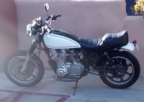 blakeem
I brought the frame and swing-arm home today. I was able to fit it in the back of my 1986.5 Supra and close the hatch. The frame is a lot smaller and lighter than I expected.
A bunch more brown water came out of the frame near the back of the seat tube. I looked into what to use and I'm deciding between LPS 3, Boeshield T-9, and ACF-50. Right now I'm thinking ACF-50 will be best to coat the inside of the frame, they say that it should last about a year.
Here's my checklist of things to do while I have the frame at home.
The shop is a bit far so now that the frame is at home I can make a lot more progress. I really want to get this done and ride it.
I looked into the YZF600R forks, it seems that it has a different size front axle than the KZ1000p so I'm not sure if I could use the stock wheel. I'll need to look into it some more.
A bunch more brown water came out of the frame near the back of the seat tube. I looked into what to use and I'm deciding between LPS 3, Boeshield T-9, and ACF-50. Right now I'm thinking ACF-50 will be best to coat the inside of the frame, they say that it should last about a year.
Here's my checklist of things to do while I have the frame at home.
- Grind and sand everything that's left and make it ready for sand blasting/powder coating
- Get all the water out of the frame and coat the inside with Rust Inhibitor/Protector
- Wire everything up to the frame so I know how much space I'll need and where my grounds are.
- Build an aluminium box under the seat for holding the electronics
- Build a custom seat pan (fiberglass or metal). Upholstery will come last.
- Have tabs welded for rear sets.
The shop is a bit far so now that the frame is at home I can make a lot more progress. I really want to get this done and ride it.
I looked into the YZF600R forks, it seems that it has a different size front axle than the KZ1000p so I'm not sure if I could use the stock wheel. I'll need to look into it some more.
KZ650c - new member with hopefully an easy wheel ? was created by Fixer
01 Apr 2015 10:01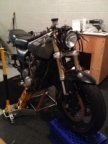 Fixer
Fixer
Hello KZR Members, happy to be here.
I recently bought a 77 KZ 650c and the plan is to make it a "streetfighter". I am basically a garage mechanic, not an expert and certainly no fabricator, but I can work on cars and bikes and have successfully in the past created a cool cafe sportster out of a stock Nightster.
So, along with my 7 yr old daughter (she calls herself The Fixer, hence the nickname) we will be working on making the KZ something unique to us.
I already bought a GSXR front end and sent the triple tree in to Cognito Moto to have a new stem pressed in and new bearings from All Balls as well.
I have decided to keep the stock swingarm but to get a more balanced look and ride with the new front rim (120/70/zr17) I was thinking it might be best to just swap out my stock mag 120/90/18 wheel/rim combo for a used 3x16 rim off ebay from another KZ 650.
the question I have specifically is, if I buy a rim that does not have the sprocket and disc attached, is it a direct swap to remove those items from my current stock 18 inch wheel and bolt them right to the new 16 inch wheel?
I can get the basic rim pretty cheap on ebay, and it would be somewhat confidence inspiring knowing that the brake disc and sprocket are remaining exactly the same from the donor bike.
I also plan on selling the front end , rear wheel and tire, and other assorted items I got from the seller. I will be posting those in classified soon.
thanks everyone!
I recently bought a 77 KZ 650c and the plan is to make it a "streetfighter". I am basically a garage mechanic, not an expert and certainly no fabricator, but I can work on cars and bikes and have successfully in the past created a cool cafe sportster out of a stock Nightster.
So, along with my 7 yr old daughter (she calls herself The Fixer, hence the nickname) we will be working on making the KZ something unique to us.
I already bought a GSXR front end and sent the triple tree in to Cognito Moto to have a new stem pressed in and new bearings from All Balls as well.
I have decided to keep the stock swingarm but to get a more balanced look and ride with the new front rim (120/70/zr17) I was thinking it might be best to just swap out my stock mag 120/90/18 wheel/rim combo for a used 3x16 rim off ebay from another KZ 650.
the question I have specifically is, if I buy a rim that does not have the sprocket and disc attached, is it a direct swap to remove those items from my current stock 18 inch wheel and bolt them right to the new 16 inch wheel?
I can get the basic rim pretty cheap on ebay, and it would be somewhat confidence inspiring knowing that the brake disc and sprocket are remaining exactly the same from the donor bike.
I also plan on selling the front end , rear wheel and tire, and other assorted items I got from the seller. I will be posting those in classified soon.
thanks everyone!
 Drooz
Drooz
loudhvx wrote: Looks good. Using those forks brings the wheel center in line with the fork axis, but the original geometry was designed to have leading axle forks. I think that means more trail (but shorter wheel base). They were pretty twitchy stock. I use a fork brace and a steering damper to reduce the squirrel factor. Any plans to change the steering angle?
Thanks for your interest and support.
 Other than the fork brace and damper, did you make any other handling adjustments? Did you raise the rear end?
I'm not sure what this change in geometry will have on the handling. I don't have any plans to change the steering angle at the moment.
I've made changes on my other bikes without any adverse effects. The most radical was with the 750 h2 Triple. I shortened the swingarm 2 1/2" and went from a 19"front wheel to a 16"!! I half expected it to toss me into the ditch the first time I tried to navigate a curve but it didn't! In fact, It tracks beautifully accelerating hard to 110 mph and handles the left/right transitions with ease. Go figure. :dry:
That said, I'll be very careful with this one too and work my way up to speed gradually.
 I'll be sure to report my findings when we get her out on the track in May.
 I've got an "old school" hoop fork brace on mine now. No steering damper yet. Great idea though!
Replied by 650ed on topic Garage Queen - 1978 KZ650
30 Mar 2015 08:49 650ed
650ed
That's an AMAZING find!!! I'm really glad to see that you do not plan to modify it. The are precious few stock KZ650-C2 bikes still in existence. It's beautiful with the original paint, etc! If you have any questions or run into any problems be sure to ask on this forum. There are plenty of knowledgeable folks here.
Here are some tips that you may find helpful:
Many newbies and not so newbies run into or issues with their bikes which could be easily avoided with a little preparation or information. Here are a couple recommendations that I hope you will find useful.
Before riding your KZ you should take a little time to become familiar with it. Simple things like checking the oil, tire pressures, etc. are explained in the Kawasaki Owner's Manual. If you bike didn't come with one (they normally are in a little holder on the bottom of the seat) you can usually find one on eBay - be sure to get one for your exact year/model.
MANUAL
You really should consider buying the Kawasaki Factory Service Manual for your bike. The factory service manual provides instructions on the various maintenance procedures and schedules for your bike, procedures for diagnosing problems, proper torque values for the various fasteners (VERY IMPORTANT), and insight into how each system on your bike works even if you are not repairing that system. Studying the manual before you attempt performing service on your bike will impart an understanding of the system you are working on which will increase the odds of success.
The manuals usually are readily available for most models on eBay and other sources; but be sure to get one that has your specific year and model in it as there are differences between the various KZ650 models. I do not recommend Clymers, Haynes, or other aftermarket manuals as I have seen instances where they provide inaccurate advice. You may decide to use those to supplement the factory manual, but in my opinion they are not a suitable substitute. If you have trouble finding one for your model ask us to help.
TOOLS
WARNING! Do not even try to use Phillips screwdrivers on the Kawasaki cross head screws. Despite their appearance they are not Phillips screws. They are Japanese Industrial Standard (JIS) screws. The tips of Phillips screwdrivers are too long & pointed to allow the 4 blades of the screwdriver to properly engage the screws, so when you apply force the screw head slots will deform and look like crap. The fact is that Phillips screws were deliberately designed to have the screwdriver bit "cam out." This was done to prevent production line assembly from over-tightening, stripping, or breaking the screws. JIS screws do not have this problem. A proper fitting JIS bit can tighten a JIS screw to and beyond the torque spec without camming out. Here's the good news - you can easily modify standard Phillips screwdriver tips to fit the JIS screws.
I have ground down the tips of DeWalt #2 and DeWalt #3 Phillips to make them fit JIS screws. The large crosshead screws on the cases take modified #3 bits (or genuine #3 JIS bits). To modify the DeWalt bits you need to grind the very tip a little, then test fit, then grind a little more and test fit, etc. until the bit no longer "rocks" back and forth in the screwhead. Picture 1 below shows how a DeWalt #3 bit fits the case screws of my KZ650 after being ground properly. The #2 DeWalt bits can be modified the same way to fit smaller JIS screws. Pictures 2 and 3 below shows DeWalt #2 and #3 modified bits.
I did find a place that sells authentic JIS bits. They don't list the #3 bit, but if you contact them they can provide the #3 JIS bits even though they are not listed on the website. These folks were very easy to work with, and the authentic bits do work great. Here's their site:
www.rjrcooltools.com/shop_item_detail.cfm?subcat_ID=89
Pictures 4 & 5 below show a comparison between my home made modified bits with the authentic JIS bits.
PICTURE 1

PICTURE 2

PICTURE 3

PICTURE 4

PICTURE 5

Before reaching for that wrench or ratchet consider the following. The bolts are steel, but your engine and front forks are aluminum. The bolts are much tougher than the aluminum and if over tightened will strip the aluminum threads. Although these can be repaired, preventing damage by applying proper torque will save you grief, time, and money. Tightening fasteners properly requires torque wrenches. Various vendors, including Snap-on, CDI, Sears, etc., market torque wrenches. The two most popular types are the bar type and micrometer type. Either will work, but the micrometer type is a bit easier to use, especially if you are tightening several fasteners with the same torque - such as cylinder head covers. You will need a torque wrench calibrated in INCH POUNDS for many of the bolts. You will also need a torque wrench calibrated in FOOT POUNDS for the larger bolts. Don't try to use the foot pounds wrench on the smaller bolts as it will not be sensitive enough at low torque settings to provide accurate torque. There are many fasteners that require low torque. These include such things as 6mm oil pan bolts, cylinder head cover bolts, etc. for which the torque in 61-78 inch pounds. These low torque bolts require a wrench that is accurate at low settings and this wrench should be graduated in inch pounds. In addition, there are numerous high torque fasteners such as the front axle nuts (51 - 65 foot pounds) or swing arm pivot shaft nuts (58 - 87 foot pounds). These require a wrench that is accurate at higher settings; this wrench should be graduated in foot pounds. Using the proper torque wrenches to correctly tighten fasteners will help prevent damage and contribute to a safe bike. The Kawasaki Service Manual will list the various torque specs for the bolts. I suggest you get the manual before buying the torque wrenches so you can decide which wrenches best meet the torque specs.
Consider buying a can of Kroil penetrating oil and use it to soak stubborn fasteners for a couple days before trying to loosen them. Remember, the original screws and bolts were installed on your bike when Jimmy Carter was President, so many of them may be hard to remove. Kroil can be bought online, at guns shows, and at some other venues.
MOTOR OIL
The ingredients in oils have changed over the years. For example, today's Castrol GTX oil (and pretty much all other AUTOMOBILE oil) is not the same as it was in the 1980's. Back then it worked great in KZ bikes. But, things have changed. Early AUTOMOBILE oils contained zinc phosphorus compounds (ZDDP) to protect engine components from metal to metal contact. This was good for engines, but it was found to be destructive to catalytic converters. Consequently, in AUTOMOBILE oils ZDDP was virtually eliminated and replaced with different chemistry generically referred to as "Friction Modifiers." These work fine and offer good protection for normal AUTOMOBILE engines. However, today's AUTOMOBILE oil "Friction Modifiers" are destructive to wet clutches. KZ bikes (and many other brands) have wet clutches. As a result of these oil chemistry changes a distinction needed to be made between those oils which are suitable for wet clutches and those which are not. That distinction was documented by the Japanese Engine Oil Standards Implementation Panel (JASO). JASO developed a number of different oil specifications for different applications. The specifications that apply to 4 stroke motorcycles fall under the "4T Specifications." Within the 4T specifications the JASO MA class oils are specifically formulated for 4 stroke motorcycles with wet clutches.
There are synthetic, semi-synthetic, and non-synthetic oils that meet the JASO-MA standard and any of them will work ok. However, using oils that are not designated as meeting the JASO-MA standard is destructive to KZ clutches.
Good luck with your bike. Ed
Here are some tips that you may find helpful:
Many newbies and not so newbies run into or issues with their bikes which could be easily avoided with a little preparation or information. Here are a couple recommendations that I hope you will find useful.
Before riding your KZ you should take a little time to become familiar with it. Simple things like checking the oil, tire pressures, etc. are explained in the Kawasaki Owner's Manual. If you bike didn't come with one (they normally are in a little holder on the bottom of the seat) you can usually find one on eBay - be sure to get one for your exact year/model.
MANUAL
You really should consider buying the Kawasaki Factory Service Manual for your bike. The factory service manual provides instructions on the various maintenance procedures and schedules for your bike, procedures for diagnosing problems, proper torque values for the various fasteners (VERY IMPORTANT), and insight into how each system on your bike works even if you are not repairing that system. Studying the manual before you attempt performing service on your bike will impart an understanding of the system you are working on which will increase the odds of success.
The manuals usually are readily available for most models on eBay and other sources; but be sure to get one that has your specific year and model in it as there are differences between the various KZ650 models. I do not recommend Clymers, Haynes, or other aftermarket manuals as I have seen instances where they provide inaccurate advice. You may decide to use those to supplement the factory manual, but in my opinion they are not a suitable substitute. If you have trouble finding one for your model ask us to help.
TOOLS
WARNING! Do not even try to use Phillips screwdrivers on the Kawasaki cross head screws. Despite their appearance they are not Phillips screws. They are Japanese Industrial Standard (JIS) screws. The tips of Phillips screwdrivers are too long & pointed to allow the 4 blades of the screwdriver to properly engage the screws, so when you apply force the screw head slots will deform and look like crap. The fact is that Phillips screws were deliberately designed to have the screwdriver bit "cam out." This was done to prevent production line assembly from over-tightening, stripping, or breaking the screws. JIS screws do not have this problem. A proper fitting JIS bit can tighten a JIS screw to and beyond the torque spec without camming out. Here's the good news - you can easily modify standard Phillips screwdriver tips to fit the JIS screws.
I have ground down the tips of DeWalt #2 and DeWalt #3 Phillips to make them fit JIS screws. The large crosshead screws on the cases take modified #3 bits (or genuine #3 JIS bits). To modify the DeWalt bits you need to grind the very tip a little, then test fit, then grind a little more and test fit, etc. until the bit no longer "rocks" back and forth in the screwhead. Picture 1 below shows how a DeWalt #3 bit fits the case screws of my KZ650 after being ground properly. The #2 DeWalt bits can be modified the same way to fit smaller JIS screws. Pictures 2 and 3 below shows DeWalt #2 and #3 modified bits.
I did find a place that sells authentic JIS bits. They don't list the #3 bit, but if you contact them they can provide the #3 JIS bits even though they are not listed on the website. These folks were very easy to work with, and the authentic bits do work great. Here's their site:
www.rjrcooltools.com/shop_item_detail.cfm?subcat_ID=89
Pictures 4 & 5 below show a comparison between my home made modified bits with the authentic JIS bits.
PICTURE 1
PICTURE 2
PICTURE 3
PICTURE 4
PICTURE 5
Before reaching for that wrench or ratchet consider the following. The bolts are steel, but your engine and front forks are aluminum. The bolts are much tougher than the aluminum and if over tightened will strip the aluminum threads. Although these can be repaired, preventing damage by applying proper torque will save you grief, time, and money. Tightening fasteners properly requires torque wrenches. Various vendors, including Snap-on, CDI, Sears, etc., market torque wrenches. The two most popular types are the bar type and micrometer type. Either will work, but the micrometer type is a bit easier to use, especially if you are tightening several fasteners with the same torque - such as cylinder head covers. You will need a torque wrench calibrated in INCH POUNDS for many of the bolts. You will also need a torque wrench calibrated in FOOT POUNDS for the larger bolts. Don't try to use the foot pounds wrench on the smaller bolts as it will not be sensitive enough at low torque settings to provide accurate torque. There are many fasteners that require low torque. These include such things as 6mm oil pan bolts, cylinder head cover bolts, etc. for which the torque in 61-78 inch pounds. These low torque bolts require a wrench that is accurate at low settings and this wrench should be graduated in inch pounds. In addition, there are numerous high torque fasteners such as the front axle nuts (51 - 65 foot pounds) or swing arm pivot shaft nuts (58 - 87 foot pounds). These require a wrench that is accurate at higher settings; this wrench should be graduated in foot pounds. Using the proper torque wrenches to correctly tighten fasteners will help prevent damage and contribute to a safe bike. The Kawasaki Service Manual will list the various torque specs for the bolts. I suggest you get the manual before buying the torque wrenches so you can decide which wrenches best meet the torque specs.
Consider buying a can of Kroil penetrating oil and use it to soak stubborn fasteners for a couple days before trying to loosen them. Remember, the original screws and bolts were installed on your bike when Jimmy Carter was President, so many of them may be hard to remove. Kroil can be bought online, at guns shows, and at some other venues.
MOTOR OIL
The ingredients in oils have changed over the years. For example, today's Castrol GTX oil (and pretty much all other AUTOMOBILE oil) is not the same as it was in the 1980's. Back then it worked great in KZ bikes. But, things have changed. Early AUTOMOBILE oils contained zinc phosphorus compounds (ZDDP) to protect engine components from metal to metal contact. This was good for engines, but it was found to be destructive to catalytic converters. Consequently, in AUTOMOBILE oils ZDDP was virtually eliminated and replaced with different chemistry generically referred to as "Friction Modifiers." These work fine and offer good protection for normal AUTOMOBILE engines. However, today's AUTOMOBILE oil "Friction Modifiers" are destructive to wet clutches. KZ bikes (and many other brands) have wet clutches. As a result of these oil chemistry changes a distinction needed to be made between those oils which are suitable for wet clutches and those which are not. That distinction was documented by the Japanese Engine Oil Standards Implementation Panel (JASO). JASO developed a number of different oil specifications for different applications. The specifications that apply to 4 stroke motorcycles fall under the "4T Specifications." Within the 4T specifications the JASO MA class oils are specifically formulated for 4 stroke motorcycles with wet clutches.
There are synthetic, semi-synthetic, and non-synthetic oils that meet the JASO-MA standard and any of them will work ok. However, using oils that are not designated as meeting the JASO-MA standard is destructive to KZ clutches.
Good luck with your bike. Ed
Replied by NobleHops on topic The Friendship Bike - NobleHops restores a 75 Z1
29 Mar 2015 07:43
NobleHops
OK, I owe this thread an update.
Thanks first off to Stein, for maintaining and restoring this forum after it was attacked. It's mystifying to me how people could find hacking community websites like this one to be a worthwhile use of their skills.
Much progress to report. As prior, the carbs are all the way apart and blasted and ultrasonally cleaned, and my rebuild kits arrived a few days ago. Will tackle that shortly, but at the moment I am concentrating on disassembly so I can get some stuff sent out for coating, plating, etc.
I had some good conscripted labor to work with, and so we did most of the primary disassemblh early last week - got the engine out and safely on a dolly, good to go.


Broke it down a little further, extracted the steering head and swingarm bearings, photo'd the motor mounts and battery box assemblies, and got all the black bits together, and down to a local powdercoater.


Have been evolving my system a bit on this project - laying out the subassemblies as I disassemble them, measuring and noting the fasteners, then into the bins for replating. I'll have a half-day of sorting to do to get them back together at reassembly, but I'm going to save a bloody fortune on fasteners on this project and the nice replaced zinc stuff looks amazing.

We are very nearly all the way apart at this point - need to get the plating sent out ASAP, I am of course making a list of parts I need as I go, have another big parts order to make. I need to get the rims off the hubs next so I can evaluate them for replating or repainting, and then I'll be ready to start getting the chassis back to a roller and turn my attention to the engine.
There is a big pile of boxes in the foyer as I type this from Z1parts.net and it is taking all my self control to not tear them open and unpack and fondle the new bodywork. I won't last forever though.
Thanks first off to Stein, for maintaining and restoring this forum after it was attacked. It's mystifying to me how people could find hacking community websites like this one to be a worthwhile use of their skills.
Much progress to report. As prior, the carbs are all the way apart and blasted and ultrasonally cleaned, and my rebuild kits arrived a few days ago. Will tackle that shortly, but at the moment I am concentrating on disassembly so I can get some stuff sent out for coating, plating, etc.
I had some good conscripted labor to work with, and so we did most of the primary disassemblh early last week - got the engine out and safely on a dolly, good to go.
Broke it down a little further, extracted the steering head and swingarm bearings, photo'd the motor mounts and battery box assemblies, and got all the black bits together, and down to a local powdercoater.
Have been evolving my system a bit on this project - laying out the subassemblies as I disassemble them, measuring and noting the fasteners, then into the bins for replating. I'll have a half-day of sorting to do to get them back together at reassembly, but I'm going to save a bloody fortune on fasteners on this project and the nice replaced zinc stuff looks amazing.
We are very nearly all the way apart at this point - need to get the plating sent out ASAP, I am of course making a list of parts I need as I go, have another big parts order to make. I need to get the rims off the hubs next so I can evaluate them for replating or repainting, and then I'll be ready to start getting the chassis back to a roller and turn my attention to the engine.
There is a big pile of boxes in the foyer as I type this from Z1parts.net and it is taking all my self control to not tear them open and unpack and fondle the new bodywork. I won't last forever though
. Replied by 650ed on topic First Bike! XD
29 Mar 2015 05:44
650ed
Welcome aboard! Wow, that bike has survived in beautiful condition! I hope you don't plan to modify it. Here are some tips that you may find helpful:
Many newbies and not so newbies run into or issues with their bikes which could be easily avoided with a little preparation or information. Here are a couple recommendations that I hope you will find useful.
Before riding your KZ you should take a little time to become familiar with it. Simple things like checking the oil, tire pressures, etc. are explained in the Kawasaki Owner's Manual. If you bike didn't come with one (they normally are in a little holder on the bottom of the seat) you can usually find one on eBay - be sure to get one for your exact year/model.
MANUAL
You really should consider buying the Kawasaki Factory Service Manual for your bike. The factory service manual provides instructions on the various maintenance procedures and schedules for your bike, procedures for diagnosing problems, proper torque values for the various fasteners (VERY IMPORTANT), and insight into how each system on your bike works even if you are not repairing that system. Studying the manual before you attempt performing service on your bike will impart an understanding of the system you are working on which will increase the odds of success.
The manuals usually are readily available for most models on eBay and other sources; but be sure to get one that has your specific year and model in it as there are differences between the various KZ650 models. I do not recommend Clymers, Haynes, or other aftermarket manuals as I have seen instances where they provide inaccurate advice. You may decide to use those to supplement the factory manual, but in my opinion they are not a suitable substitute. If you have trouble finding one for your model ask us to help.
TOOLS
WARNING! Do not even try to use Phillips screwdrivers on the Kawasaki cross head screws. Despite their appearance they are not Phillips screws. They are Japanese Industrial Standard (JIS) screws. The tips of Phillips screwdrivers are too long & pointed to allow the 4 blades of the screwdriver to properly engage the screws, so when you apply force the screw head slots will deform and look like crap. The fact is that Phillips screws were deliberately designed to have the screwdriver bit "cam out." This was done to prevent production line assembly from over-tightening, stripping, or breaking the screws. JIS screws do not have this problem. A proper fitting JIS bit can tighten a JIS screw to and beyond the torque spec without camming out. Here's the good news - you can easily modify standard Phillips screwdriver tips to fit the JIS screws.
I have ground down the tips of DeWalt #2 and DeWalt #3 Phillips to make them fit JIS screws. The large crosshead screws on the cases take modified #3 bits (or genuine #3 JIS bits). To modify the DeWalt bits you need to grind the very tip a little, then test fit, then grind a little more and test fit, etc. until the bit no longer "rocks" back and forth in the screwhead. Picture 1 below shows how a DeWalt #3 bit fits the case screws of my KZ650 after being ground properly. The #2 DeWalt bits can be modified the same way to fit smaller JIS screws. Pictures 2 and 3 below shows DeWalt #2 and #3 modified bits.
I did find a place that sells authentic JIS bits. They don't list the #3 bit, but if you contact them they can provide the #3 JIS bits even though they are not listed on the website. These folks were very easy to work with, and the authentic bits do work great. Here's their site:
www.rjrcooltools.com/shop_item_detail.cfm?subcat_ID=89
Pictures 4 & 5 below show a comparison between my home made modified bits with the authentic JIS bits.
PICTURE 1
PICTURE 2
PICTURE 3
PICTURE 4
PICTURE 5
Before reaching for that wrench or ratchet consider the following. The bolts are steel, but your engine and front forks are aluminum. The bolts are much tougher than the aluminum and if over tightened will strip the aluminum threads. Although these can be repaired, preventing damage by applying proper torque will save you grief, time, and money. Tightening fasteners properly requires torque wrenches. Various vendors, including Snap-on, CDI, Sears, etc., market torque wrenches. The two most popular types are the bar type and micrometer type. Either will work, but the micrometer type is a bit easier to use, especially if you are tightening several fasteners with the same torque - such as cylinder head covers. You will need a torque wrench calibrated in INCH POUNDS for many of the bolts. You will also need a torque wrench calibrated in FOOT POUNDS for the larger bolts. Don't try to use the foot pounds wrench on the smaller bolts as it will not be sensitive enough at low torque settings to provide accurate torque. There are many fasteners that require low torque. These include such things as 6mm oil pan bolts, cylinder head cover bolts, etc. for which the torque in 61-78 inch pounds. These low torque bolts require a wrench that is accurate at low settings and this wrench should be graduated in inch pounds. In addition, there are numerous high torque fasteners such as the front axle nuts (51 - 65 foot pounds) or swing arm pivot shaft nuts (58 - 87 foot pounds). These require a wrench that is accurate at higher settings; this wrench should be graduated in foot pounds. Using the proper torque wrenches to correctly tighten fasteners will help prevent damage and contribute to a safe bike. The Kawasaki Service Manual will list the various torque specs for the bolts. I suggest you get the manual before buying the torque wrenches so you can decide which wrenches best meet the torque specs.
Consider buying a can of Kroil penetrating oil and use it to soak stubborn fasteners for a couple days before trying to loosen them. Remember, the original screws and bolts were installed on your bike when Jimmy Carter was President, so many of them may be hard to remove. Kroil can be bought online, at guns shows, and at some other venues.
MOTOR OIL
The ingredients in oils have changed over the years. For example, today's Castrol GTX oil (and pretty much all other AUTOMOBILE oil) is not the same as it was in the 1980's. Back then it worked great in KZ bikes. But, things have changed. Early AUTOMOBILE oils contained zinc phosphorus compounds (ZDDP) to protect engine components from metal to metal contact. This was good for engines, but it was found to be destructive to catalytic converters. Consequently, in AUTOMOBILE oils ZDDP was virtually eliminated and replaced with different chemistry generically referred to as "Friction Modifiers." These work fine and offer good protection for normal AUTOMOBILE engines. However, today's AUTOMOBILE oil "Friction Modifiers" are destructive to wet clutches. KZ bikes (and many other brands) have wet clutches. As a result of these oil chemistry changes a distinction needed to be made between those oils which are suitable for wet clutches and those which are not. That distinction was documented by the Japanese Engine Oil Standards Implementation Panel (JASO). JASO developed a number of different oil specifications for different applications. The specifications that apply to 4 stroke motorcycles fall under the "4T Specifications." Within the 4T specifications the JASO MA class oils are specifically formulated for 4 stroke motorcycles with wet clutches.
There are synthetic, semi-synthetic, and non-synthetic oils that meet the JASO-MA standard and any of them will work ok. However, using oils that are not designated as meeting the JASO-MA standard is destructive to KZ clutches.
Good luck with your bike. Ed
Many newbies and not so newbies run into or issues with their bikes which could be easily avoided with a little preparation or information. Here are a couple recommendations that I hope you will find useful.
Before riding your KZ you should take a little time to become familiar with it. Simple things like checking the oil, tire pressures, etc. are explained in the Kawasaki Owner's Manual. If you bike didn't come with one (they normally are in a little holder on the bottom of the seat) you can usually find one on eBay - be sure to get one for your exact year/model.
MANUAL
You really should consider buying the Kawasaki Factory Service Manual for your bike. The factory service manual provides instructions on the various maintenance procedures and schedules for your bike, procedures for diagnosing problems, proper torque values for the various fasteners (VERY IMPORTANT), and insight into how each system on your bike works even if you are not repairing that system. Studying the manual before you attempt performing service on your bike will impart an understanding of the system you are working on which will increase the odds of success.
The manuals usually are readily available for most models on eBay and other sources; but be sure to get one that has your specific year and model in it as there are differences between the various KZ650 models. I do not recommend Clymers, Haynes, or other aftermarket manuals as I have seen instances where they provide inaccurate advice. You may decide to use those to supplement the factory manual, but in my opinion they are not a suitable substitute. If you have trouble finding one for your model ask us to help.
TOOLS
WARNING! Do not even try to use Phillips screwdrivers on the Kawasaki cross head screws. Despite their appearance they are not Phillips screws. They are Japanese Industrial Standard (JIS) screws. The tips of Phillips screwdrivers are too long & pointed to allow the 4 blades of the screwdriver to properly engage the screws, so when you apply force the screw head slots will deform and look like crap. The fact is that Phillips screws were deliberately designed to have the screwdriver bit "cam out." This was done to prevent production line assembly from over-tightening, stripping, or breaking the screws. JIS screws do not have this problem. A proper fitting JIS bit can tighten a JIS screw to and beyond the torque spec without camming out. Here's the good news - you can easily modify standard Phillips screwdriver tips to fit the JIS screws.
I have ground down the tips of DeWalt #2 and DeWalt #3 Phillips to make them fit JIS screws. The large crosshead screws on the cases take modified #3 bits (or genuine #3 JIS bits). To modify the DeWalt bits you need to grind the very tip a little, then test fit, then grind a little more and test fit, etc. until the bit no longer "rocks" back and forth in the screwhead. Picture 1 below shows how a DeWalt #3 bit fits the case screws of my KZ650 after being ground properly. The #2 DeWalt bits can be modified the same way to fit smaller JIS screws. Pictures 2 and 3 below shows DeWalt #2 and #3 modified bits.
I did find a place that sells authentic JIS bits. They don't list the #3 bit, but if you contact them they can provide the #3 JIS bits even though they are not listed on the website. These folks were very easy to work with, and the authentic bits do work great. Here's their site:
www.rjrcooltools.com/shop_item_detail.cfm?subcat_ID=89
Pictures 4 & 5 below show a comparison between my home made modified bits with the authentic JIS bits.
PICTURE 1
PICTURE 2
PICTURE 3
PICTURE 4
PICTURE 5
Before reaching for that wrench or ratchet consider the following. The bolts are steel, but your engine and front forks are aluminum. The bolts are much tougher than the aluminum and if over tightened will strip the aluminum threads. Although these can be repaired, preventing damage by applying proper torque will save you grief, time, and money. Tightening fasteners properly requires torque wrenches. Various vendors, including Snap-on, CDI, Sears, etc., market torque wrenches. The two most popular types are the bar type and micrometer type. Either will work, but the micrometer type is a bit easier to use, especially if you are tightening several fasteners with the same torque - such as cylinder head covers. You will need a torque wrench calibrated in INCH POUNDS for many of the bolts. You will also need a torque wrench calibrated in FOOT POUNDS for the larger bolts. Don't try to use the foot pounds wrench on the smaller bolts as it will not be sensitive enough at low torque settings to provide accurate torque. There are many fasteners that require low torque. These include such things as 6mm oil pan bolts, cylinder head cover bolts, etc. for which the torque in 61-78 inch pounds. These low torque bolts require a wrench that is accurate at low settings and this wrench should be graduated in inch pounds. In addition, there are numerous high torque fasteners such as the front axle nuts (51 - 65 foot pounds) or swing arm pivot shaft nuts (58 - 87 foot pounds). These require a wrench that is accurate at higher settings; this wrench should be graduated in foot pounds. Using the proper torque wrenches to correctly tighten fasteners will help prevent damage and contribute to a safe bike. The Kawasaki Service Manual will list the various torque specs for the bolts. I suggest you get the manual before buying the torque wrenches so you can decide which wrenches best meet the torque specs.
Consider buying a can of Kroil penetrating oil and use it to soak stubborn fasteners for a couple days before trying to loosen them. Remember, the original screws and bolts were installed on your bike when Jimmy Carter was President, so many of them may be hard to remove. Kroil can be bought online, at guns shows, and at some other venues.
MOTOR OIL
The ingredients in oils have changed over the years. For example, today's Castrol GTX oil (and pretty much all other AUTOMOBILE oil) is not the same as it was in the 1980's. Back then it worked great in KZ bikes. But, things have changed. Early AUTOMOBILE oils contained zinc phosphorus compounds (ZDDP) to protect engine components from metal to metal contact. This was good for engines, but it was found to be destructive to catalytic converters. Consequently, in AUTOMOBILE oils ZDDP was virtually eliminated and replaced with different chemistry generically referred to as "Friction Modifiers." These work fine and offer good protection for normal AUTOMOBILE engines. However, today's AUTOMOBILE oil "Friction Modifiers" are destructive to wet clutches. KZ bikes (and many other brands) have wet clutches. As a result of these oil chemistry changes a distinction needed to be made between those oils which are suitable for wet clutches and those which are not. That distinction was documented by the Japanese Engine Oil Standards Implementation Panel (JASO). JASO developed a number of different oil specifications for different applications. The specifications that apply to 4 stroke motorcycles fall under the "4T Specifications." Within the 4T specifications the JASO MA class oils are specifically formulated for 4 stroke motorcycles with wet clutches.
There are synthetic, semi-synthetic, and non-synthetic oils that meet the JASO-MA standard and any of them will work ok. However, using oils that are not designated as meeting the JASO-MA standard is destructive to KZ clutches.
Good luck with your bike. Ed
Displaying 1541 - 1550 out of 7257 results.