
Search Results (Searched for: gs swing arm)
Replied by 531blackbanshee on topic KZ1100 LTD Shaft swingarm swap help
21 Jul 2015 13:45 - 21 Jul 2015 13:48 531blackbanshee
precisely.
but,my thought would be to machine 32085 and 33032 as one piece that the bolts would then go through like arnolds.
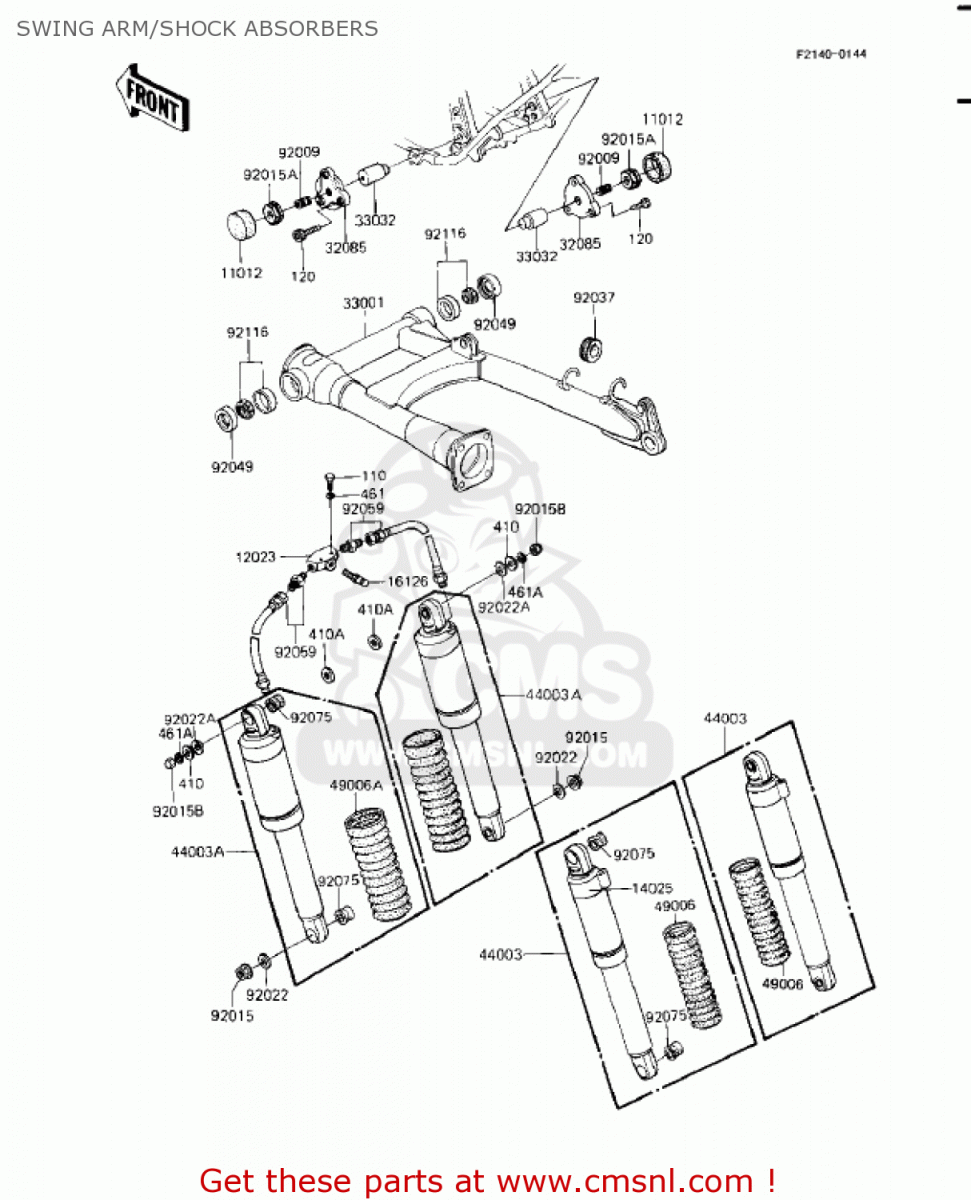
then you would install the axle in the arm slide the spacers over each end,then install the whole assembly in the frame and then put the newly machined frame fittings in and tighten the bolts and your done.
arnolds off on a fishing trip and won't be checking back in for a bit,otherwise he would be here to tell us all about it :lol: .
leon
but,my thought would be to machine 32085 and 33032 as one piece that the bolts would then go through like arnolds.
then you would install the axle in the arm slide the spacers over each end,then install the whole assembly in the frame and then put the newly machined frame fittings in and tighten the bolts and your done.
arnolds off on a fishing trip and won't be checking back in for a bit,otherwise he would be here to tell us all about it :lol: .
leon
Replied by 531blackbanshee on topic KZ1100 LTD Shaft swingarm swap help
21 Jul 2015 06:02
531blackbanshee
the 03/04 stuff is good to use you are gonna lose some ride height because the forks are a lil shorter and the 17" wheels.
but a carefully selected exhaust and some gullwing type upper triples can negate that .
the front end will need "tuned" for the weight .a call to a suspension house progressive/racetech etc.should sort out a set of springs to take care of that.
a stem swap will make it a bolt on.
machining tophats/spacers for the pivot should sort that.
weld some shock mounts on the arm and modify the brake caliper bracket to lean it back to clear the shocks and the rearend is sorted.
hth,
leon
but a carefully selected exhaust and some gullwing type upper triples can negate that .
the front end will need "tuned" for the weight .a call to a suspension house progressive/racetech etc.should sort out a set of springs to take care of that.
a stem swap will make it a bolt on.
machining tophats/spacers for the pivot should sort that.
weld some shock mounts on the arm and modify the brake caliper bracket to lean it back to clear the shocks and the rearend is sorted.
hth,
leon
Replied by KZGrrl on topic KZ1100 LTD Shaft swingarm swap help
20 Jul 2015 09:12 KZGrrl
I'll probably go with the forks, swingarm, and wheels from a ZX-6R. That seems like the most common front end swap. From what I've been able to find the 03-04 ZX-6R swingarm is 242mm wide at the pivot, which leaves 50mm to space things out.
With the ZX6R forks, do they need to be modified for the different weight of the bike?
With the ZX6R forks, do they need to be modified for the different weight of the bike?
Replied by KZGrrl on topic KZ1100 LTD Shaft swingarm swap help
17 Jul 2015 06:22 - 17 Jul 2015 06:22
KZGrrl
After some more googling I came across this (Amazing) build, which does a chain conversion as well as a swingarm swap.
kzrider.com/forum/11-projects/550823-ret...one?start=260#611315
It seems all he did to fit his new arm is machine some bushings to fit the old mounts and use spacers to take up the slack.
kzrider.com/forum/11-projects/550823-ret...one?start=260#611315
It seems all he did to fit his new arm is machine some bushings to fit the old mounts and use spacers to take up the slack.
Wow, those are much cheaper than the GS arms.I went with a GSXR600 arm with a Bandit 600 wheel , which allowed for a 160 tyre. Of course there are other options but this is what worked for me.
Replied by davido on topic KZ1100 LTD Shaft swingarm swap help
17 Jul 2015 00:19 - 17 Jul 2015 00:45 davido
Im not sure how the shaft/chain conversion goes,(though I do remember someone here doin it with an ST. ) I would think that the drive conversion and the swingarm swap would be 2 different projects. Someone else might be able to point you in the right direction on that.
I tried a GS1100 swingarm in my bike and it fit very easily but I couldnt get a 180 tyre into it. I tried a 160 but that wouldnt work either. Someone posted that the GS took a 140 tyre ( I think) which wasnt big enough for what I wanted.
In the end,I went with a GSXR600 arm with a Bandit 600 wheel , which allowed for a 160 tyre. Of course there are other options but this is what worked for me.
Dont worry about shock mounts as you can have them welded onto whatever arm you end up with.
Good luck
I tried a GS1100 swingarm in my bike and it fit very easily but I couldnt get a 180 tyre into it. I tried a 160 but that wouldnt work either. Someone posted that the GS took a 140 tyre ( I think) which wasnt big enough for what I wanted.
In the end,I went with a GSXR600 arm with a Bandit 600 wheel , which allowed for a 160 tyre. Of course there are other options but this is what worked for me.
Dont worry about shock mounts as you can have them welded onto whatever arm you end up with.
Good luck
Replied by 650ed on topic New KZ Owner-Issues to be aware of?
16 Jul 2015 20:41 650ed
650ed
Welcome aboard!
Here are some tips that you may find helpful:
Many newbies and not so newbies run into or issues with their bikes which could be easily avoided with a little preparation or information. Here are a couple recommendations that I hope you will find useful.
Before riding your KZ you should take a little time to become familiar with it. Simple things like checking the oil, tire pressures, etc. are explained in the Kawasaki Owner's Manual. If you bike didn't come with one (they normally are in a little holder on the bottom of the seat) you can usually find one on eBay - be sure to get one for your exact year/model.
MANUAL
You really should consider buying the Kawasaki Factory Service Manual for your bike. The factory service manual provides instructions on the various maintenance procedures and schedules for your bike, procedures for diagnosing problems, proper torque values for the various fasteners (VERY IMPORTANT), and insight into how each system on your bike works even if you are not repairing that system. Studying the manual before you attempt performing service on your bike will impart an understanding of the system you are working on which will increase the odds of success.
The manuals usually are readily available for most models on eBay and other sources; but be sure to get one that has your specific year and model in it as there are differences between the various KZ650 models. I do not recommend Clymers, Haynes, or other aftermarket manuals as I have seen instances where they provide inaccurate advice. You may decide to use those to supplement the factory manual, but in my opinion they are not a suitable substitute. If you have trouble finding one for your model ask us to help.
TOOLS
WARNING! Do not even try to use Phillips screwdrivers on the Kawasaki cross head screws. Despite their appearance they are not Phillips screws. They are Japanese Industrial Standard (JIS) screws. The tips of Phillips screwdrivers are too long & pointed to allow the 4 blades of the screwdriver to properly engage the screws, so when you apply force the screw head slots will deform and look like crap. The fact is that Phillips screws were deliberately designed to have the screwdriver bit "cam out." This was done to prevent production line assembly from over-tightening, stripping, or breaking the screws. JIS screws do not have this problem. A proper fitting JIS bit can tighten a JIS screw to and beyond the torque spec without camming out. Here's the good news - you can easily modify standard Phillips screwdriver tips to fit the JIS screws.
I have ground down the tips of DeWalt #2 and DeWalt #3 Phillips to make them fit JIS screws. The large crosshead screws on the cases take modified #3 bits (or genuine #3 JIS bits). To modify the DeWalt bits you need to grind the very tip a little, then test fit, then grind a little more and test fit, etc. until the bit no longer "rocks" back and forth in the screwhead. Picture 1 below shows how a DeWalt #3 bit fits the case screws of my KZ650 after being ground properly. The #2 DeWalt bits can be modified the same way to fit smaller JIS screws. Pictures 2 and 3 below shows DeWalt #2 and #3 modified bits.
I did find a place that sells authentic JIS bits. They don't list the #3 bit, but if you contact them they can provide the #3 JIS bits even though they are not listed on the website. These folks were very easy to work with, and the authentic bits do work great. Here's their site:
www.rjrcooltools.com/shop_item_detail.cfm?subcat_ID=89
Pictures 4 & 5 below show a comparison between my home made modified bits with the authentic JIS bits.
PICTURE 1

PICTURE 2

PICTURE 3

PICTURE 4

PICTURE 5

Before reaching for that wrench or ratchet consider the following. The bolts are steel, but your engine and front forks are aluminum. The bolts are much tougher than the aluminum and if over tightened will strip the aluminum threads. Although these can be repaired, preventing damage by applying proper torque will save you grief, time, and money. Tightening fasteners properly requires torque wrenches. Various vendors, including Snap-on, CDI, Sears, etc., market torque wrenches. The two most popular types are the bar type and micrometer type. Either will work, but the micrometer type is a bit easier to use, especially if you are tightening several fasteners with the same torque - such as cylinder head covers. You will need a torque wrench calibrated in INCH POUNDS for many of the bolts. You will also need a torque wrench calibrated in FOOT POUNDS for the larger bolts. Don't try to use the foot pounds wrench on the smaller bolts as it will not be sensitive enough at low torque settings to provide accurate torque. There are many fasteners that require low torque. These include such things as 6mm oil pan bolts, cylinder head cover bolts, etc. for which the torque in 61-78 inch pounds. These low torque bolts require a wrench that is accurate at low settings and this wrench should be graduated in inch pounds. In addition, there are numerous high torque fasteners such as the front axle nuts (51 - 65 foot pounds) or swing arm pivot shaft nuts (58 - 87 foot pounds). These require a wrench that is accurate at higher settings; this wrench should be graduated in foot pounds. Using the proper torque wrenches to correctly tighten fasteners will help prevent damage and contribute to a safe bike. The Kawasaki Service Manual will list the various torque specs for the bolts. I suggest you get the manual before buying the torque wrenches so you can decide which wrenches best meet the torque specs.
Consider buying a can of Kroil penetrating oil and use it to soak stubborn fasteners for a couple days before trying to loosen them. Remember, the original screws and bolts were installed on your bike when Jimmy Carter was President, so many of them may be hard to remove. Kroil can be bought online, at guns shows, and at some other venues.
MOTOR OIL
The ingredients in oils have changed over the years. For example, today's Castrol GTX oil (and pretty much all other AUTOMOBILE oil) is not the same as it was in the 1980's. Back then it worked great in KZ bikes. But, things have changed. Early AUTOMOBILE oils contained zinc phosphorus compounds (ZDDP) to protect engine components from metal to metal contact. This was good for engines, but it was found to be destructive to catalytic converters. Consequently, in AUTOMOBILE oils ZDDP was virtually eliminated and replaced with different chemistry generically referred to as "Friction Modifiers." These work fine and offer good protection for normal AUTOMOBILE engines. However, today's AUTOMOBILE oil "Friction Modifiers" are destructive to wet clutches. KZ bikes (and many other brands) have wet clutches. As a result of these oil chemistry changes a distinction needed to be made between those oils which are suitable for wet clutches and those which are not. That distinction was documented by the Japanese Engine Oil Standards Implementation Panel (JASO). JASO developed a number of different oil specifications for different applications. The specifications that apply to 4 stroke motorcycles fall under the "4T Specifications." Within the 4T specifications the JASO MA class oils are specifically formulated for 4 stroke motorcycles with wet clutches.
There are synthetic, semi-synthetic, and non-synthetic oils that meet the JASO-MA standard and any of them will work ok. However, using oils that are not designated as meeting the JASO-MA standard is destructive to KZ clutches.
Good luck with your bike. Ed
Here are some tips that you may find helpful:
Many newbies and not so newbies run into or issues with their bikes which could be easily avoided with a little preparation or information. Here are a couple recommendations that I hope you will find useful.
Before riding your KZ you should take a little time to become familiar with it. Simple things like checking the oil, tire pressures, etc. are explained in the Kawasaki Owner's Manual. If you bike didn't come with one (they normally are in a little holder on the bottom of the seat) you can usually find one on eBay - be sure to get one for your exact year/model.
MANUAL
You really should consider buying the Kawasaki Factory Service Manual for your bike. The factory service manual provides instructions on the various maintenance procedures and schedules for your bike, procedures for diagnosing problems, proper torque values for the various fasteners (VERY IMPORTANT), and insight into how each system on your bike works even if you are not repairing that system. Studying the manual before you attempt performing service on your bike will impart an understanding of the system you are working on which will increase the odds of success.
The manuals usually are readily available for most models on eBay and other sources; but be sure to get one that has your specific year and model in it as there are differences between the various KZ650 models. I do not recommend Clymers, Haynes, or other aftermarket manuals as I have seen instances where they provide inaccurate advice. You may decide to use those to supplement the factory manual, but in my opinion they are not a suitable substitute. If you have trouble finding one for your model ask us to help.
TOOLS
WARNING! Do not even try to use Phillips screwdrivers on the Kawasaki cross head screws. Despite their appearance they are not Phillips screws. They are Japanese Industrial Standard (JIS) screws. The tips of Phillips screwdrivers are too long & pointed to allow the 4 blades of the screwdriver to properly engage the screws, so when you apply force the screw head slots will deform and look like crap. The fact is that Phillips screws were deliberately designed to have the screwdriver bit "cam out." This was done to prevent production line assembly from over-tightening, stripping, or breaking the screws. JIS screws do not have this problem. A proper fitting JIS bit can tighten a JIS screw to and beyond the torque spec without camming out. Here's the good news - you can easily modify standard Phillips screwdriver tips to fit the JIS screws.
I have ground down the tips of DeWalt #2 and DeWalt #3 Phillips to make them fit JIS screws. The large crosshead screws on the cases take modified #3 bits (or genuine #3 JIS bits). To modify the DeWalt bits you need to grind the very tip a little, then test fit, then grind a little more and test fit, etc. until the bit no longer "rocks" back and forth in the screwhead. Picture 1 below shows how a DeWalt #3 bit fits the case screws of my KZ650 after being ground properly. The #2 DeWalt bits can be modified the same way to fit smaller JIS screws. Pictures 2 and 3 below shows DeWalt #2 and #3 modified bits.
I did find a place that sells authentic JIS bits. They don't list the #3 bit, but if you contact them they can provide the #3 JIS bits even though they are not listed on the website. These folks were very easy to work with, and the authentic bits do work great. Here's their site:
www.rjrcooltools.com/shop_item_detail.cfm?subcat_ID=89
Pictures 4 & 5 below show a comparison between my home made modified bits with the authentic JIS bits.
PICTURE 1
PICTURE 2
PICTURE 3
PICTURE 4
PICTURE 5
Before reaching for that wrench or ratchet consider the following. The bolts are steel, but your engine and front forks are aluminum. The bolts are much tougher than the aluminum and if over tightened will strip the aluminum threads. Although these can be repaired, preventing damage by applying proper torque will save you grief, time, and money. Tightening fasteners properly requires torque wrenches. Various vendors, including Snap-on, CDI, Sears, etc., market torque wrenches. The two most popular types are the bar type and micrometer type. Either will work, but the micrometer type is a bit easier to use, especially if you are tightening several fasteners with the same torque - such as cylinder head covers. You will need a torque wrench calibrated in INCH POUNDS for many of the bolts. You will also need a torque wrench calibrated in FOOT POUNDS for the larger bolts. Don't try to use the foot pounds wrench on the smaller bolts as it will not be sensitive enough at low torque settings to provide accurate torque. There are many fasteners that require low torque. These include such things as 6mm oil pan bolts, cylinder head cover bolts, etc. for which the torque in 61-78 inch pounds. These low torque bolts require a wrench that is accurate at low settings and this wrench should be graduated in inch pounds. In addition, there are numerous high torque fasteners such as the front axle nuts (51 - 65 foot pounds) or swing arm pivot shaft nuts (58 - 87 foot pounds). These require a wrench that is accurate at higher settings; this wrench should be graduated in foot pounds. Using the proper torque wrenches to correctly tighten fasteners will help prevent damage and contribute to a safe bike. The Kawasaki Service Manual will list the various torque specs for the bolts. I suggest you get the manual before buying the torque wrenches so you can decide which wrenches best meet the torque specs.
Consider buying a can of Kroil penetrating oil and use it to soak stubborn fasteners for a couple days before trying to loosen them. Remember, the original screws and bolts were installed on your bike when Jimmy Carter was President, so many of them may be hard to remove. Kroil can be bought online, at guns shows, and at some other venues.
MOTOR OIL
The ingredients in oils have changed over the years. For example, today's Castrol GTX oil (and pretty much all other AUTOMOBILE oil) is not the same as it was in the 1980's. Back then it worked great in KZ bikes. But, things have changed. Early AUTOMOBILE oils contained zinc phosphorus compounds (ZDDP) to protect engine components from metal to metal contact. This was good for engines, but it was found to be destructive to catalytic converters. Consequently, in AUTOMOBILE oils ZDDP was virtually eliminated and replaced with different chemistry generically referred to as "Friction Modifiers." These work fine and offer good protection for normal AUTOMOBILE engines. However, today's AUTOMOBILE oil "Friction Modifiers" are destructive to wet clutches. KZ bikes (and many other brands) have wet clutches. As a result of these oil chemistry changes a distinction needed to be made between those oils which are suitable for wet clutches and those which are not. That distinction was documented by the Japanese Engine Oil Standards Implementation Panel (JASO). JASO developed a number of different oil specifications for different applications. The specifications that apply to 4 stroke motorcycles fall under the "4T Specifications." Within the 4T specifications the JASO MA class oils are specifically formulated for 4 stroke motorcycles with wet clutches.
There are synthetic, semi-synthetic, and non-synthetic oils that meet the JASO-MA standard and any of them will work ok. However, using oils that are not designated as meeting the JASO-MA standard is destructive to KZ clutches.
Good luck with your bike. Ed
KZ1100 LTD Shaft swingarm swap help was created by KZGrrl
16 Jul 2015 18:47
KZGrrl
Hopefully this is in the right place :pinch:
Anyway, I recently was given a 1983 KZ1100 LTD Shaft-drive that was sitting outside for around 15 years. Needless to say it is in pretty rough condition :sick: . After about a week of meticulously cleaning the carbs, It fired up first try. Nearly every piece but the frame, engine, rims, forks, and swing arm are beyond usability. Being that it was free and in such terrible shape I felt it would be a perfect candidate for a custom build rather than try and restore it. As it sits now it is an empty frame with most of the tabs cut/ ground off.
My plan is to do the chain drive conversion and swap in a better swingarm that would allow for a wider wheel. I've spent the last day researching both the shaft-to-chain conversion, as well as the swingarm swap. I've found that the GS1100E swingarm is the most common one used, but I can't find any specific info on fitting it to a Shaft drive frame, which from what I've been able to find is wider than the chain drive models' frame. I also recall reading that the holes where the pivot bolt fit are larger on this frame? Any advice there would be very welcome. I definitely want to retain the dual shocks, so any swingarm I use needs to have those mount points. I have quite a few other questions (mainly about swapping out forks), but I will leave it there for now .
.
Thanks!
Anyway, I recently was given a 1983 KZ1100 LTD Shaft-drive that was sitting outside for around 15 years. Needless to say it is in pretty rough condition :sick: . After about a week of meticulously cleaning the carbs, It fired up first try. Nearly every piece but the frame, engine, rims, forks, and swing arm are beyond usability. Being that it was free and in such terrible shape I felt it would be a perfect candidate for a custom build rather than try and restore it. As it sits now it is an empty frame with most of the tabs cut/ ground off.
My plan is to do the chain drive conversion and swap in a better swingarm that would allow for a wider wheel. I've spent the last day researching both the shaft-to-chain conversion, as well as the swingarm swap. I've found that the GS1100E swingarm is the most common one used, but I can't find any specific info on fitting it to a Shaft drive frame, which from what I've been able to find is wider than the chain drive models' frame. I also recall reading that the holes where the pivot bolt fit are larger on this frame? Any advice there would be very welcome. I definitely want to retain the dual shocks, so any swingarm I use needs to have those mount points. I have quite a few other questions (mainly about swapping out forks), but I will leave it there for now
.Thanks!
Replied by eric951turbo on topic Backfiring 82 KZ1100. Won't start.
15 Jul 2015 08:50 eric951turbo
thanks loud,
can you confirm this list of possible causes to my problem, at this point, i can only start from the beginning:
1. Buy new spark plugs (I fooled the new ones but I did clean them, gonna buy a new set just in case)
2. Recheck the advancer, or switch with another one.
3. Recheck for the 4th time valve clearance
other than that, I dont know what to do anymore... other than swapping the swingarm and engine from my KZ1000 into my new problematic KZ1100 shaft bike.
can you confirm this list of possible causes to my problem, at this point, i can only start from the beginning:
1. Buy new spark plugs (I fooled the new ones but I did clean them, gonna buy a new set just in case)
2. Recheck the advancer, or switch with another one.
3. Recheck for the 4th time valve clearance
other than that, I dont know what to do anymore... other than swapping the swingarm and engine from my KZ1000 into my new problematic KZ1100 shaft bike.
Curious about what it's worth was created by InfernalPlacebo
14 Jul 2015 15:20
InfernalPlacebo
So I have two KZ1000J's in my possession both with all their parts. I had planned on rebuilding one of them with parts from both, one frame and swing arm is fresh powder coated. Due to work I have been unable to finish my project. I am now working away during the week (work puts me in a hotel, I'm typically 5+ hours from home) and only make it back every other weekend or so. I was considering just selling them as is (both completely disassembled, one engine runs the other has a bent rod) and buying a cheap bike used off ebay or Craigslist that I don't have to attempt to rebuild. I don't have any idea the value of these bikes so I don't know what to begin testing the waters with price-wise. Any help you guys can offer is appreciated.
 missionkz
77' KZ1000A1
Bear with me....
Pulled the wheels off this weekend installed the new Shinko Tires and had the wheels and spokes trued and balanced.
The Shinkos were quite a bit out of balance... it took 2 oz for the rear and 1.5oz for the front.
I also knocked out all the original seals and bearings for a change to 5 new All Balls, sealed bearings and seals.
I have done this bearing replacement before on a dozen or more other bikes but I had a terrible....VERY very difficult time getting the rear bearings out this time.
Seemed like the old ball bearings (about 40,000 miles)... were really stuck in the hub and the hub insides were a little corroded too... GOOD grief!!
Anyhow, I got it all done and put the wheels on.
I know I'm getting old and lazy but it took me close to four and half hours!!!
While readjusting the rear axle and chain tension... 15/35 sprocket combo.... I am now just about 1/16" past the last notch on the swing arm!! I don't think I can push the adjusting bolts in any further and the chain (cold) is still a little more slack then service limit.
Says RK 630 SO on the links.
I think it and the sprockets are just worn out.
It really only has about 6,000-7,000 miles on it and for some reason I thought it would go much longer then this.
I knew the chain wear has been moving the axle back over the years but there is virtually no adjustment left now.
So it looks like I'll be buying a new sprocket set and chain.
Not terribly interested in offset sprockets and 5 series running gear but where and what is the current good quality chain and sprocket combo?
I see 630 O'ring stuff on eBay... MUCH less $$ then what I paid for mine a few years and thousands of miles ago.. which red flags my attention as being cheap Chinese crap.
Any suggestions?
Bear with me....
Pulled the wheels off this weekend installed the new Shinko Tires and had the wheels and spokes trued and balanced.
The Shinkos were quite a bit out of balance... it took 2 oz for the rear and 1.5oz for the front.
I also knocked out all the original seals and bearings for a change to 5 new All Balls, sealed bearings and seals.
I have done this bearing replacement before on a dozen or more other bikes but I had a terrible....VERY very difficult time getting the rear bearings out this time.
Seemed like the old ball bearings (about 40,000 miles)... were really stuck in the hub and the hub insides were a little corroded too... GOOD grief!!
Anyhow, I got it all done and put the wheels on.
I know I'm getting old and lazy but it took me close to four and half hours!!!
While readjusting the rear axle and chain tension... 15/35 sprocket combo.... I am now just about 1/16" past the last notch on the swing arm!! I don't think I can push the adjusting bolts in any further and the chain (cold) is still a little more slack then service limit.
Says RK 630 SO on the links.
I think it and the sprockets are just worn out.
It really only has about 6,000-7,000 miles on it and for some reason I thought it would go much longer then this.
I knew the chain wear has been moving the axle back over the years but there is virtually no adjustment left now.
So it looks like I'll be buying a new sprocket set and chain.
Not terribly interested in offset sprockets and 5 series running gear but where and what is the current good quality chain and sprocket combo?
I see 630 O'ring stuff on eBay... MUCH less $$ then what I paid for mine a few years and thousands of miles ago.. which red flags my attention as being cheap Chinese crap.
Any suggestions?
Displaying 1411 - 1420 out of 7257 results.