
Search Results (Searched for: gs swing arm)
Replied by 531blackbanshee on topic 1975 KZ 900 , ZRX Swingarm, 89 GSXR front end
06 Mar 2015 07:47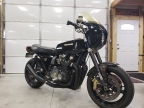 531blackbanshee
maybe i'm being an ass but after we coddled/babysat you through this build i think you owe us a nice ride video of you wringin this bad boy out  !!! :evil:
leon
!!! :evil:leon
Replied by tk11b40 on topic 1975 KZ 900 , ZRX Swingarm, 89 GSXR front end
05 Mar 2015 20:31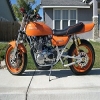 tk11b40
The Ohlins shocks Are back from the shop rebuilt and with the proper spring rate. Time to get a license plate!
Replied by davido on topic Rear Swingarm Stand
05 Mar 2015 10:49 davido
'Powerplus tools'or something like that,I dont remember the exact name but twas cheap as chips and just as flexible.
It does work better with bobbins rather than the finger type things (both attachments were included) but you get what you pay for. Monkeys and peanuts etc. It does me OK and its a nice bright HONDA red!!!!.
531blackbanshee
i have this one.
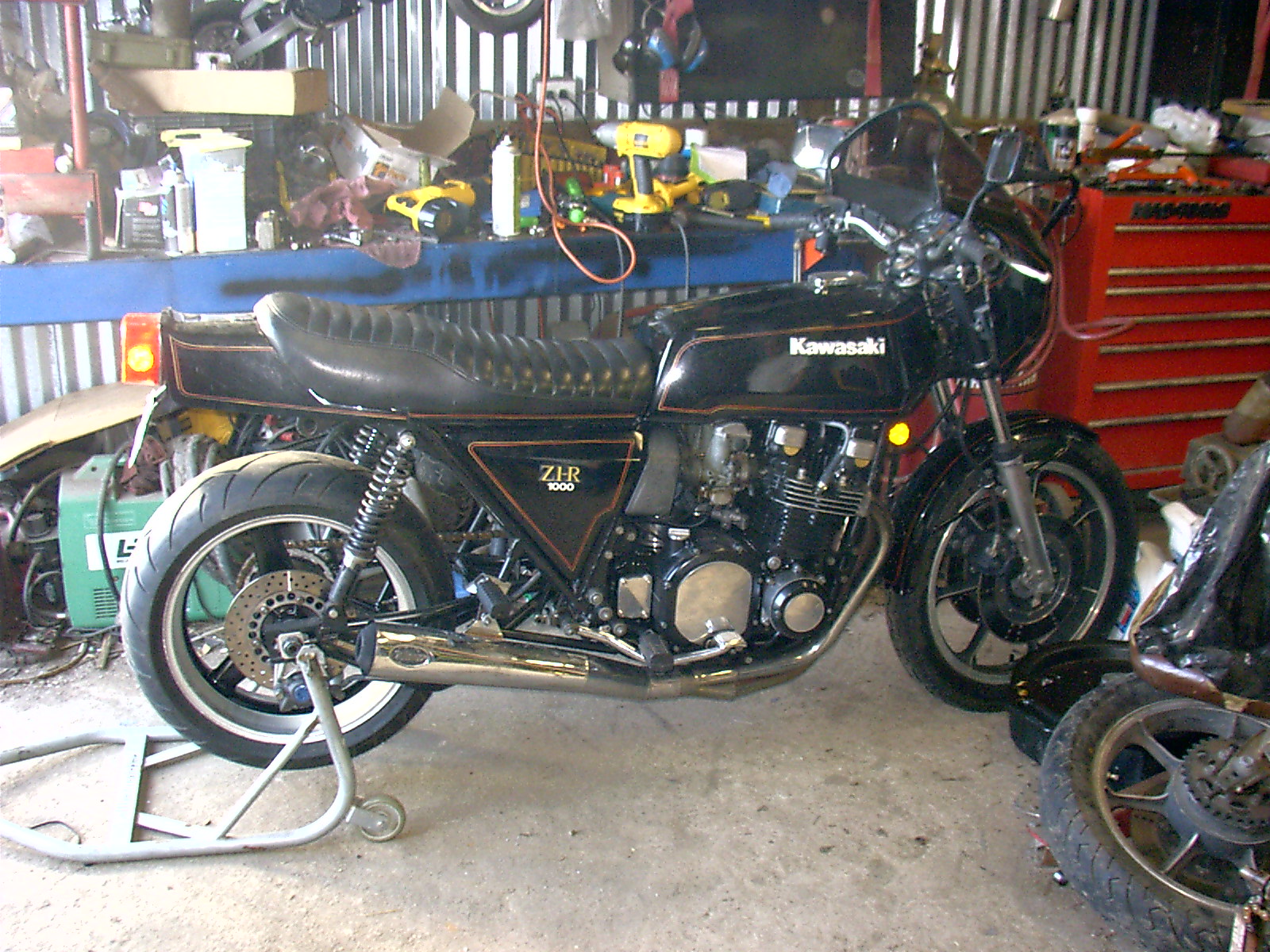
the vinyl coatings that were originally on the "hooks"that the arm sets on have long since disappeared fromm mine.so you have to be very careful about bumping the bike and it falling off the stand.
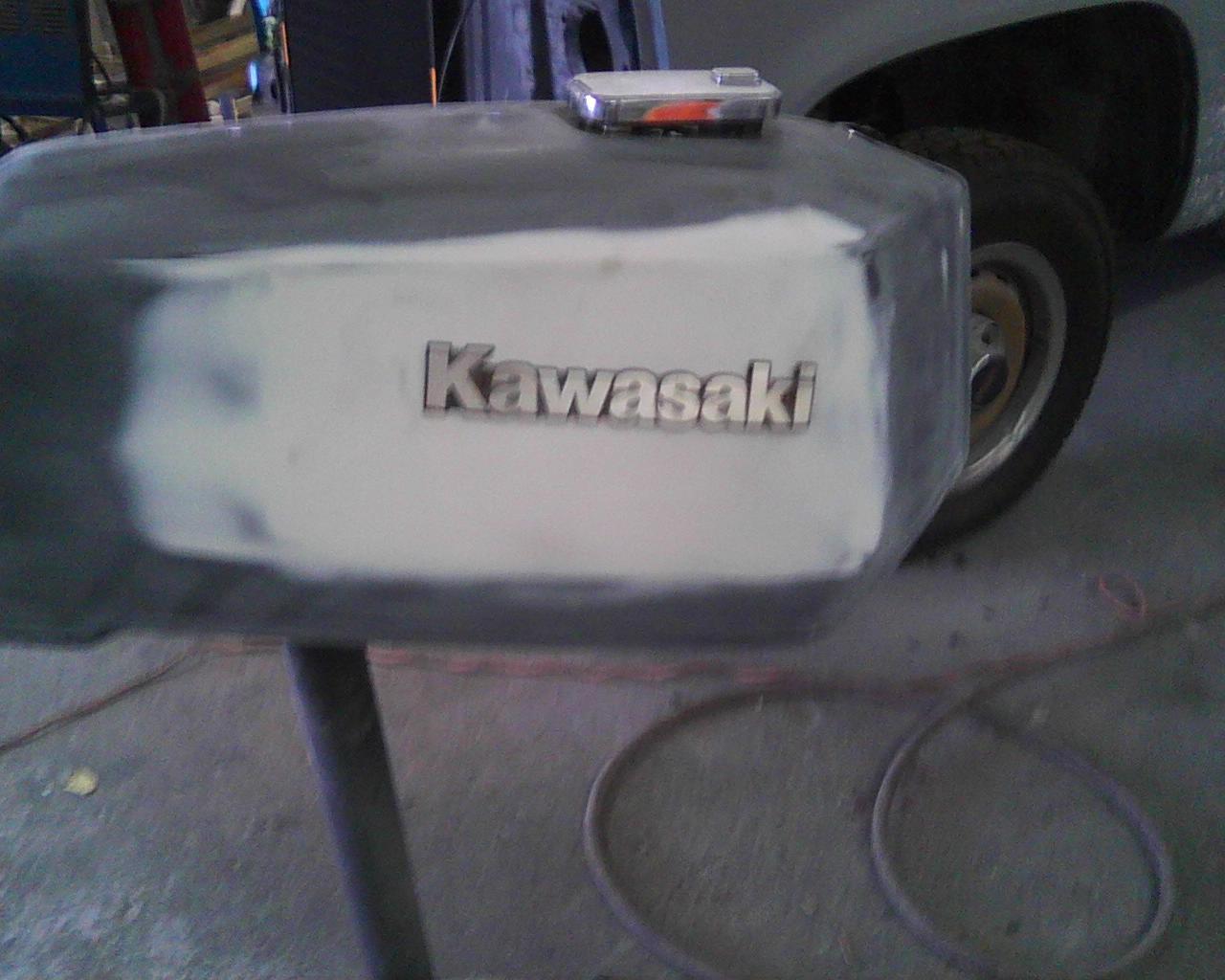
i was rolling my banshee into the shop and hit the back wheel and knocked the z1r off the stand and it fell against the switch housing of my mill and caved in the side of my tank and banged my emblem up
 !!!
!!!
so the ones that hook bobbins are the more secure in my opinion.
these old bikes seem to like to be stored setting level tho and these stands are awesome for that.
esp if you have somewhat leaky valve seals needles/seats etc.
hth,
leon
the vinyl coatings that were originally on the "hooks"that the arm sets on have long since disappeared fromm mine.so you have to be very careful about bumping the bike and it falling off the stand.
i was rolling my banshee into the shop and hit the back wheel and knocked the z1r off the stand and it fell against the switch housing of my mill and caved in the side of my tank and banged my emblem up
so the ones that hook bobbins are the more secure in my opinion.
these old bikes seem to like to be stored setting level tho and these stands are awesome for that.
esp if you have somewhat leaky valve seals needles/seats etc.
hth,
leon
Replied by 650mod on topic 650 Mod's 78 Fighter Build
03 Mar 2015 16:59 650mod
Doug- my phone wasn't loading earlier so I'm loading things up now 
Here's a look at the bung mounted up to the foot rest mount. The length of the bungs will be shortened as we figure out where exactly I want the pegs to be.
A quick view of the positioning for the peg that I was referring to. I'll have just enough room to squeeze a socket in if I need to remove the swingarm pivot bolt.
A quick side view of the mounting position. Again, the length will be shortened according to where the final resting place of the foot rests are.
Devin
Here's a look at the bung mounted up to the foot rest mount. The length of the bungs will be shortened as we figure out where exactly I want the pegs to be.
Attachment 20150303_133330450x800.jpg not found
A quick view of the positioning for the peg that I was referring to. I'll have just enough room to squeeze a socket in if I need to remove the swingarm pivot bolt.
Attachment 20150303_134419450x800.jpg not found
A quick side view of the mounting position. Again, the length will be shortened according to where the final resting place of the foot rests are.
Attachment 20150303_134435450x800.jpg not found
Devin
Replied by 650ed on topic New Z750 owner from Scotland.
01 Mar 2015 10:09 650ed
650ed
Beautiful bike! I hope you don;t plan on modifying it. Here are some tips that you may find helpful:
Many newbies and not so newbies run into or issues with their bikes which could be easily avoided with a little preparation or information. Here are a couple recommendations that I hope you will find useful.
Before riding your KZ you should take a little time to become familiar with it. Simple things like checking the oil, tire pressures, etc. are explained in the Kawasaki Owner's Manual. If you bike didn't come with one (they normally are in a little holder on the bottom of the seat) you can usually find one on eBay - be sure to get one for your exact year/model.
MANUAL
You really should consider buying the Kawasaki Factory Service Manual for your bike. The factory service manual provides instructions on the various maintenance procedures and schedules for your bike, procedures for diagnosing problems, proper torque values for the various fasteners (VERY IMPORTANT), and insight into how each system on your bike works even if you are not repairing that system. Studying the manual before you attempt performing service on your bike will impart an understanding of the system you are working on which will increase the odds of success.
The manuals usually are readily available for most models on eBay and other sources; but be sure to get one that has your specific year and model in it as there are differences between the various KZ650 models. I do not recommend Clymers, Haynes, or other aftermarket manuals as I have seen instances where they provide inaccurate advice. You may decide to use those to supplement the factory manual, but in my opinion they are not a suitable substitute. If you have trouble finding one for your model ask us to help.
TOOLS
WARNING! Do not even try to use Phillips screwdrivers on the Kawasaki cross head screws. Despite their appearance they are not Phillips screws. They are Japanese Industrial Standard (JIS) screws. The tips of Phillips screwdrivers are too long & pointed to allow the 4 blades of the screwdriver to properly engage the screws, so when you apply force the screw head slots will deform and look like crap. The fact is that Phillips screws were deliberately designed to have the screwdriver bit "cam out." This was done to prevent production line assembly from over-tightening, stripping, or breaking the screws. JIS screws do not have this problem. A proper fitting JIS bit can tighten a JIS screw to and beyond the torque spec without camming out. Here's the good news - you can easily modify standard Phillips screwdriver tips to fit the JIS screws.
I have ground down the tips of DeWalt #2 and DeWalt #3 Phillips to make them fit JIS screws. The large crosshead screws on the cases take modified #3 bits (or genuine #3 JIS bits). To modify the DeWalt bits you need to grind the very tip a little, then test fit, then grind a little more and test fit, etc. until the bit no longer "rocks" back and forth in the screwhead. Picture 1 below shows how a DeWalt #3 bit fits the case screws of my KZ650 after being ground properly. The #2 DeWalt bits can be modified the same way to fit smaller JIS screws. Pictures 2 and 3 below shows DeWalt #2 and #3 modified bits.
I did find a place that sells authentic JIS bits. They don't list the #3 bit, but if you contact them they can provide the #3 JIS bits even though they are not listed on the website. These folks were very easy to work with, and the authentic bits do work great. Here's their site:
www.rjrcooltools.com/shop_item_detail.cfm?subcat_ID=89
Pictures 4 & 5 below show a comparison between my home made modified bits with the authentic JIS bits.
PICTURE 1

PICTURE 2

PICTURE 3

PICTURE 4

PICTURE 5

Before reaching for that wrench or ratchet consider the following. The bolts are steel, but your engine and front forks are aluminum. The bolts are much tougher than the aluminum and if over tightened will strip the aluminum threads. Although these can be repaired, preventing damage by applying proper torque will save you grief, time, and money. Tightening fasteners properly requires torque wrenches. Various vendors, including Snap-on, CDI, Sears, etc., market torque wrenches. The two most popular types are the bar type and micrometer type. Either will work, but the micrometer type is a bit easier to use, especially if you are tightening several fasteners with the same torque - such as cylinder head covers. You will need a torque wrench calibrated in INCH POUNDS for many of the bolts. You will also need a torque wrench calibrated in FOOT POUNDS for the larger bolts. Don't try to use the foot pounds wrench on the smaller bolts as it will not be sensitive enough at low torque settings to provide accurate torque. There are many fasteners that require low torque. These include such things as 6mm oil pan bolts, cylinder head cover bolts, etc. for which the torque in 61-78 inch pounds. These low torque bolts require a wrench that is accurate at low settings and this wrench should be graduated in inch pounds. In addition, there are numerous high torque fasteners such as the front axle nuts (51 - 65 foot pounds) or swing arm pivot shaft nuts (58 - 87 foot pounds). These require a wrench that is accurate at higher settings; this wrench should be graduated in foot pounds. Using the proper torque wrenches to correctly tighten fasteners will help prevent damage and contribute to a safe bike. The Kawasaki Service Manual will list the various torque specs for the bolts. I suggest you get the manual before buying the torque wrenches so you can decide which wrenches best meet the torque specs.
Consider buying a can of Kroil penetrating oil and use it to soak stubborn fasteners for a couple days before trying to loosen them. Remember, the original screws and bolts were installed on your bike when Jimmy Carter was President, so many of them may be hard to remove. Kroil can be bought online, at guns shows, and at some other venues.
MOTOR OIL
The ingredients in oils have changed over the years. For example, today's Castrol GTX oil (and pretty much all other AUTOMOBILE oil) is not the same as it was in the 1980's. Back then it worked great in KZ bikes. But, things have changed. Early AUTOMOBILE oils contained zinc phosphorus compounds (ZDDP) to protect engine components from metal to metal contact. This was good for engines, but it was found to be destructive to catalytic converters. Consequently, in AUTOMOBILE oils ZDDP was virtually eliminated and replaced with different chemistry generically referred to as "Friction Modifiers." These work fine and offer good protection for normal AUTOMOBILE engines. However, today's AUTOMOBILE oil "Friction Modifiers" are destructive to wet clutches. KZ bikes (and many other brands) have wet clutches. As a result of these oil chemistry changes a distinction needed to be made between those oils which are suitable for wet clutches and those which are not. That distinction was documented by the Japanese Engine Oil Standards Implementation Panel (JASO). JASO developed a number of different oil specifications for different applications. The specifications that apply to 4 stroke motorcycles fall under the "4T Specifications." Within the 4T specifications the JASO MA class oils are specifically formulated for 4 stroke motorcycles with wet clutches.
There are synthetic, semi-synthetic, and non-synthetic oils that meet the JASO-MA standard and any of them will work ok. However, using oils that are not designated as meeting the JASO-MA standard is destructive to KZ clutches.
Good luck with your bike. Ed
Many newbies and not so newbies run into or issues with their bikes which could be easily avoided with a little preparation or information. Here are a couple recommendations that I hope you will find useful.
Before riding your KZ you should take a little time to become familiar with it. Simple things like checking the oil, tire pressures, etc. are explained in the Kawasaki Owner's Manual. If you bike didn't come with one (they normally are in a little holder on the bottom of the seat) you can usually find one on eBay - be sure to get one for your exact year/model.
MANUAL
You really should consider buying the Kawasaki Factory Service Manual for your bike. The factory service manual provides instructions on the various maintenance procedures and schedules for your bike, procedures for diagnosing problems, proper torque values for the various fasteners (VERY IMPORTANT), and insight into how each system on your bike works even if you are not repairing that system. Studying the manual before you attempt performing service on your bike will impart an understanding of the system you are working on which will increase the odds of success.
The manuals usually are readily available for most models on eBay and other sources; but be sure to get one that has your specific year and model in it as there are differences between the various KZ650 models. I do not recommend Clymers, Haynes, or other aftermarket manuals as I have seen instances where they provide inaccurate advice. You may decide to use those to supplement the factory manual, but in my opinion they are not a suitable substitute. If you have trouble finding one for your model ask us to help.
TOOLS
WARNING! Do not even try to use Phillips screwdrivers on the Kawasaki cross head screws. Despite their appearance they are not Phillips screws. They are Japanese Industrial Standard (JIS) screws. The tips of Phillips screwdrivers are too long & pointed to allow the 4 blades of the screwdriver to properly engage the screws, so when you apply force the screw head slots will deform and look like crap. The fact is that Phillips screws were deliberately designed to have the screwdriver bit "cam out." This was done to prevent production line assembly from over-tightening, stripping, or breaking the screws. JIS screws do not have this problem. A proper fitting JIS bit can tighten a JIS screw to and beyond the torque spec without camming out. Here's the good news - you can easily modify standard Phillips screwdriver tips to fit the JIS screws.
I have ground down the tips of DeWalt #2 and DeWalt #3 Phillips to make them fit JIS screws. The large crosshead screws on the cases take modified #3 bits (or genuine #3 JIS bits). To modify the DeWalt bits you need to grind the very tip a little, then test fit, then grind a little more and test fit, etc. until the bit no longer "rocks" back and forth in the screwhead. Picture 1 below shows how a DeWalt #3 bit fits the case screws of my KZ650 after being ground properly. The #2 DeWalt bits can be modified the same way to fit smaller JIS screws. Pictures 2 and 3 below shows DeWalt #2 and #3 modified bits.
I did find a place that sells authentic JIS bits. They don't list the #3 bit, but if you contact them they can provide the #3 JIS bits even though they are not listed on the website. These folks were very easy to work with, and the authentic bits do work great. Here's their site:
www.rjrcooltools.com/shop_item_detail.cfm?subcat_ID=89
Pictures 4 & 5 below show a comparison between my home made modified bits with the authentic JIS bits.
PICTURE 1
PICTURE 2
PICTURE 3
PICTURE 4
PICTURE 5
Before reaching for that wrench or ratchet consider the following. The bolts are steel, but your engine and front forks are aluminum. The bolts are much tougher than the aluminum and if over tightened will strip the aluminum threads. Although these can be repaired, preventing damage by applying proper torque will save you grief, time, and money. Tightening fasteners properly requires torque wrenches. Various vendors, including Snap-on, CDI, Sears, etc., market torque wrenches. The two most popular types are the bar type and micrometer type. Either will work, but the micrometer type is a bit easier to use, especially if you are tightening several fasteners with the same torque - such as cylinder head covers. You will need a torque wrench calibrated in INCH POUNDS for many of the bolts. You will also need a torque wrench calibrated in FOOT POUNDS for the larger bolts. Don't try to use the foot pounds wrench on the smaller bolts as it will not be sensitive enough at low torque settings to provide accurate torque. There are many fasteners that require low torque. These include such things as 6mm oil pan bolts, cylinder head cover bolts, etc. for which the torque in 61-78 inch pounds. These low torque bolts require a wrench that is accurate at low settings and this wrench should be graduated in inch pounds. In addition, there are numerous high torque fasteners such as the front axle nuts (51 - 65 foot pounds) or swing arm pivot shaft nuts (58 - 87 foot pounds). These require a wrench that is accurate at higher settings; this wrench should be graduated in foot pounds. Using the proper torque wrenches to correctly tighten fasteners will help prevent damage and contribute to a safe bike. The Kawasaki Service Manual will list the various torque specs for the bolts. I suggest you get the manual before buying the torque wrenches so you can decide which wrenches best meet the torque specs.
Consider buying a can of Kroil penetrating oil and use it to soak stubborn fasteners for a couple days before trying to loosen them. Remember, the original screws and bolts were installed on your bike when Jimmy Carter was President, so many of them may be hard to remove. Kroil can be bought online, at guns shows, and at some other venues.
MOTOR OIL
The ingredients in oils have changed over the years. For example, today's Castrol GTX oil (and pretty much all other AUTOMOBILE oil) is not the same as it was in the 1980's. Back then it worked great in KZ bikes. But, things have changed. Early AUTOMOBILE oils contained zinc phosphorus compounds (ZDDP) to protect engine components from metal to metal contact. This was good for engines, but it was found to be destructive to catalytic converters. Consequently, in AUTOMOBILE oils ZDDP was virtually eliminated and replaced with different chemistry generically referred to as "Friction Modifiers." These work fine and offer good protection for normal AUTOMOBILE engines. However, today's AUTOMOBILE oil "Friction Modifiers" are destructive to wet clutches. KZ bikes (and many other brands) have wet clutches. As a result of these oil chemistry changes a distinction needed to be made between those oils which are suitable for wet clutches and those which are not. That distinction was documented by the Japanese Engine Oil Standards Implementation Panel (JASO). JASO developed a number of different oil specifications for different applications. The specifications that apply to 4 stroke motorcycles fall under the "4T Specifications." Within the 4T specifications the JASO MA class oils are specifically formulated for 4 stroke motorcycles with wet clutches.
There are synthetic, semi-synthetic, and non-synthetic oils that meet the JASO-MA standard and any of them will work ok. However, using oils that are not designated as meeting the JASO-MA standard is destructive to KZ clutches.
Good luck with your bike. Ed
Replied by Vorbeck on topic top engine mounts
01 Mar 2015 07:14 Vorbeck
Yoshimura , top motor mount kit. I ran into a guy that knows another guy and they both have k_z 1000's that are raced on track days. Gs1100 swinging arm, frame brace kit, engine mount kit, & a big f****** oil cooler. I don't have the money yet to get the trick brakes and wheels. over $3000 for one bike just in wheels and brakes. I just need to find the top engine mount kit or better photograph of the Yoshimura one. there's are too big and noticeable for what I'm going to do it just didn't look right from the side to me.
Replied by 650mod on topic 650 Mod's 78 Fighter Build
26 Feb 2015 19:20
650mod
Alright, so we made some progress tonight. After some mock ups and head scratching, I decided that the best way to mount my rear sets up was going to be by making mounting bungs out of round stock and threading it. The plate steel idea put the peg too far back, and would have made for an awkward riding position.
So here's what we did. We took round stock, put it in the lathe, and drilled the centre out. We then threaded the hole to accept my mounting bolts. These bungs will be mounted up on the flat steel that surrounds the swingarm bolt. We checked for clearance, and with the pegs in place, I can still get a socket on to take the swingarm out if needed. More pictures will be up after, but we spun down 4 1" bungs to hold my rider pegs on. The passenger bungs will be made next time.
More pics will be loaded as progress is made
So here's what we did. We took round stock, put it in the lathe, and drilled the centre out. We then threaded the hole to accept my mounting bolts. These bungs will be mounted up on the flat steel that surrounds the swingarm bolt. We checked for clearance, and with the pegs in place, I can still get a socket on to take the swingarm out if needed. More pictures will be up after, but we spun down 4 1" bungs to hold my rider pegs on. The passenger bungs will be made next time.
Attachment 20150226_190011450x800.jpg not found
More pics will be loaded as progress is made
No eBay APP ID and/or Cert ID defined in Kunena configurationReplied by kaw-a-holic on topic OEM z1 900 frame support?
24 Feb 2015 15:19 kaw-a-holic
No eBay APP ID and/or Cert ID defined in Kunena configuration
Bolts right in with spacers, that's the swingarm I'm using. Glad I got mine when I did, the price has doubled since last year.
davido wrote:
Bolts right in with spacers, that's the swingarm I'm using. Glad I got mine when I did, the price has doubled since last year.
No eBay APP ID and/or Cert ID defined in Kunena configurationReplied by davido on topic OEM z1 900 frame support?
24 Feb 2015 12:16
davido
No eBay APP ID and/or Cert ID defined in Kunena configuration
Displaying 1571 - 1580 out of 7257 results.